


Table of Contents
- 1 What Is UV Curing Light?
- 2 The Science Behind UV Curing Light
- 3 What Makes a UV Light Effective for Curing?
- 4 Industrial Benefits of UV Curing Light
- 5 UV Curing Light Sources in Industrial Systems
- 6 UV Curing Light in Industrial Manufacturing: Resin Workflows and Light-Curing Adhesives
- 7 Choosing the Right UV Curing Light Source
- 8 Customization and UV Curing Lamp Engineering Support
- 9 Regulations, Compliance, and Industry Developments
- 10 FAQs About UV Curing Light
- 10.1 1) What is UV curing light, and how is it different from UV light in general?
- 10.2 2) How do photoinitiators affect cure speed and cure depth in UV systems?
- 10.3 3) What factors determine the best UV light for curing resin in post-cure workflows?
- 10.4 4) How does UV light support 3D printing and resin post-curing without turning your process into a trial-and-error step?
- 10.5 5) How can OEMs private-label specialty lamps and sockets for their equipment?
- 11 UV Curing Light Resources and Next Steps
What Is UV Curing Light?
UV curing light refers to high-intensity ultraviolet radiation used to rapidly cure or harden photosensitive materials, such as inks, coatings, adhesives, and resins. Unlike traditional drying methods that rely on evaporation or heat, UV curing light initiates a photochemical reaction that transforms liquid formulations into solid polymers in seconds. This reaction is triggered when UV light activates photoinitiators, specialized molecules embedded in the formulation that release reactive species (free radicals or cations), initiating polymer crosslinking. The result is a fast, durable, and consistent cure that enhances surface hardness, chemical resistance, and overall product quality.
It’s essential to distinguish UV curing light from the lamp or device that generates it. The term “light” refers to the actual ultraviolet radiation, primarily in the UVA and UVC spectrum, that interacts with the materials being cured. The “lamp” (whether mercury vapor, metal halide, LED, or amalgam) is the source that emits this light. Different lamp types offer varying intensities and spectral outputs depending on the application, but all are designed with one purpose: to deliver precisely the wavelengths needed to drive efficient photopolymerization.
UV curing light plays a critical role in today’s advanced manufacturing environments, offering speed, precision, and energy efficiency across industries such as automotive, electronics, medical devices, and packaging. For a broader look at the curing process and its benefits, visit our UV Curing Overview.
The Science Behind UV Curing Light
At the core of UV curing is a chemical process known as photopolymerization, a rapid transformation in which liquid materials are converted into solid polymers upon exposure to ultraviolet light. This transformation is made possible by photoinitiators, which are light-sensitive compounds embedded in the formulations of UV-curable inks, coatings, or adhesives. When irradiated with UV light at specific wavelengths, photoinitiators break down into reactive species (typically free radicals or cations) that trigger a cascade of crosslinking reactions among monomers and oligomers. This process effectively “freezes” the liquid material into a durable, chemically stable solid.

Different UV wavelengths influence how and how well this curing occurs. The UVA range (320–400 nm) is widely used in industrial applications because of its deeper penetration and compatibility with many photoinitiators, making it ideal for curing thicker layers or substrates with lower surface energy. The UVB range (280–320 nm) is less commonly used but can contribute to surface curing in select applications. The UVC range (200–280 nm) is highly energetic and often used in specialty curing systems, especially where surface sterilization or shallow, hard cures are necessary. Many curing systems use a broad-spectrum approach to optimize crosslinking at multiple depths and cure profiles.
Understanding this interplay among wavelength, photoinitiator chemistry, and cure depth is essential for engineers specifying the best UV light for curing resin. It ensures compatibility between light source and formulation, resulting in more consistent cures, higher throughput, and better product performance.
What Makes a UV Light Effective for Curing?
The effectiveness of a UV curing light depends on several critical factors that directly influence the speed, consistency, and reliability of the curing process. Chief among these is peak irradiance, or the maximum intensity of UV energy delivered to the substrate. High irradiance levels can accelerate surface cure, but must be balanced with exposure time to ensure adequate depth of cure, especially when working with thicker layers or pigmented materials.
Equally important is spectral match, the alignment between the lamp’s output wavelength and the absorption range of the photoinitiator in the ink, adhesive, or coating. Without this alignment, even high-intensity UV light may fail to trigger complete polymerization, resulting in undercured material or poor adhesion.
The substrate’s surface energy also plays a role. Non-absorbent or low-surface-energy materials, such as plastics, glass, and foils, may require optimized light dosage and specialized formulations to ensure proper wetting and adhesion. Compared to thermal curing, which relies on heat conduction and evaporation, UV curing offers greater control, instant results, and minimal substrate distortion, making it ideal for heat-sensitive or precision-engineered components.
Industrial Benefits of UV Curing Light
UV resin curing light technology has become a game-changer in advanced manufacturing, offering speed, precision, and environmental advantages over traditional thermal and solvent-based processes. Below is a breakdown of key benefits and how they impact industrial operations:
Rapid Cure Times for High-Speed Production
- Instant polymerization: UV light initiates curing within seconds, transforming liquid coatings, inks, or adhesives into durable solids.
- Higher throughput: Production lines benefit from reduced bottlenecks, enabling faster turnaround and lower labor costs.
- Zero dry time: Unlike heat-curing or solvent evaporation, UV curing requires no post-process wait—parts can move immediately to the next step.
Low-VOC and Environmentally Safer
- Minimal emissions: UV-curable formulations are typically solvent-free, significantly reducing volatile organic compound (VOC) output.
- Regulatory compliance: UV curing helps companies meet air-quality regulations, such as U.S. EPA guidelines for low- or no-VOC coatings and inks.
- Cleaner workspace: Fewer emissions mean a safer and healthier environment for workers, especially in enclosed or high-volume facilities.
Low-Heat Process Suitable for Sensitive Substrates
- Thermal stability: Because UV curing does not rely on high temperatures, it’s ideal for heat-sensitive substrates like plastics, composites, and certain electronics.
- Dimensional integrity: UV light cures only the targeted material surface, reducing the risk of warping or distortion during processing.
Compatibility with Challenging Surfaces
- Works on non-porous materials: Traditional inks and coatings often struggle to bond to plastics, glass, and metals due to low surface energy.
- Reliable adhesion: UV curing forms a surface-level crosslinked film that does not depend on absorption, resulting in smudge-free, high-resolution finishes even on difficult materials.
- Improved image quality: This makes UV light curing ideal for high-end printing, labeling, and decorative applications where clarity and durability matter.
Consistent, High-Quality Results
- Controlled curing zones: UV curing can be precisely targeted, making it suitable for applications where uniformity and accuracy are critical.
- Repeatable outcomes: Once dialed in, UV systems deliver consistent performance from batch to batch, minimizing waste and rework.
UV curing light isn’t just faster, it’s smarter. By delivering cleaner processes, sharper finishes, and broader material compatibility, it supports next-generation manufacturing across industries such as medical device assembly, automotive coatings, electronics, packaging, and aerospace. Explore UV Curing Applications to see how these benefits translate across real-world industrial sectors.
UV Curing Light Sources in Industrial Systems
Industrial UV curing systems typically use arc-based lamp technologies when high intensity, broad spectral output, or robust production duty cycles are required. In practice, engineers specify the UV curing light characteristics first (wavelength range, intensity, and exposure window), then select the hardware that can deliver those conditions consistently at line speed. That hardware is often referred to as a UV light-curing lamp, but the best UV resin-curing light ultimately comes from the complete lamp-and-optics package that delivers energy to the working surface.
LightSources is a leading manufacturer of high-tech UV lamps used in various critical applications, including UV curing. LightSources offers a range of industrial UV curing lamps and assistance in choosing the best UV light for curing resin to your specifications.
Medium-pressure UV (MPUV): Medium-pressure UV light-curing lamps deliver broad-spectrum output and high intensity, making them a strong fit for fast, high-throughput curing operations. These high-output mercury vapor lamps emit a broad UV spectrum spanning 200–400 nm, encompassing UVA and UVC wavelengths. They are ideal for rapid curing of inks, varnishes, and lacquers, as well as select disinfection applications.
MPUV curing lamps are commonly selected when production targets require short exposure windows, reliable cure initiation, and repeatable performance across wide web or conveyor processes. LS offers effective and durable curing lamps engineered for rugged construction with ultra-low water content quartz and precision molybdenum foil seals for reliable performance.
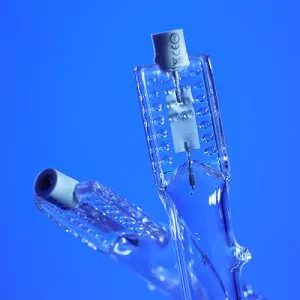
High-pressure/metal-halide: Engineered for demanding applications, high-pressure mercury lamps are enhanced with metal-halide additives, such as gallium or iron iodide, to shift UV output toward wavelengths that better match specific photoinitiator systems. This enables highly efficient curing of thick resins, composites, and 3D materials.
Typical output includes intense UVA and UVC peaks at 254 nm and 365 nm, with optional spectral ranges at 385 nm and 417 nm, depending on the application’s photoinitiator requirements. These lamps are widely used in sectors including automotive, medical, reprographics, and advanced manufacturing.
Low-pressure amalgam (specialty): Designed for energy efficiency and long service life, these low-pressure mercury lamps are enhanced with amalgam technology to deliver stable UVC output, typically at 254 nm. They can be a practical choice for select chemistries where stability, lower power draw, and process control matter more than maximum intensity.
These systems are typically used in narrower curing windows where the formulation and process conditions favor a specialized lamp approach. Low-pressure amalgam UV curing lamps offer excellent performance in environments where thermal control and power consumption are critical. Customization and OEM integration options are readily available.
UV Curing Light in Industrial Manufacturing: Resin Workflows and Light-Curing Adhesives
UV resin-curing lamps are widely used in industrial manufacturing because they enable fast, controllable polymerization in materials that must cure on demand, primarily in resin-based workflows and precision bonding applications. In both cases, performance depends less on a generic “best” light and more on specifying the correct wavelength and delivered dose for the chemistry, geometry, and throughput requirements.
Post UV Curing Performance Variables
Resin workflows in industrial environments often include a post-cure step. Post-cure performance depends on matching the UV curing light to the resin’s photoinitiator package and the part’s geometry. In practice, printed or coated resin parts may exit the initial process only partially cured, so controlled post-cure exposure is required to reach final mechanical strength, surface hardness, and chemical resistance.
In industrial systems, the critical variables typically include:
- Wavelength alignment to the resin’s photoinitiators for reliable conversion
- Intensity and uniformity to avoid undercured zones, tacky surfaces, or uneven properties
- Exposure time to reach the target dose without overheating or degrading the polymer network
- Thermal management to protect geometry and maintain process stability
- Safety enclosure and controls to manage UV exposure and support production-grade operation
LightSources supports OEMs and industrial UV lamp specifications in production environments where output consistency, duty cycle, and integration requirements are essential. Learn more about how UV curing supports research, prototyping, and controlled resin workflows.
UV Light Curing Adhesives
UV light-curing adhesives are one-component materials that remain workable until exposed to UV energy, then cure rapidly through photopolymerization. Manufacturers specify them because they enable highly repeatable assembly: teams can position parts precisely, verify alignment, and initiate cure only when ready, thereby supporting process control, reducing handling time, and reducing mixing-related errors associated with multi-part systems.
Performance is governed by the same engineering fundamentals that drive resin cure success, including:
- Photoinitiator and wavelength match for complete conversion
- Bond-line thickness and cure depth to avoid partial cure through the joint
- Shadowing and line-of-sight limitations that can leave masked regions underexposed
- Substrate transmission or opacity (clear vs. filled materials) that affects energy delivery into the bond
These adhesives are widely used in high-precision environments such as electronics assembly, medical device manufacturing, and optical bonding, where controlled cure and low thermal load matter. For a broader view of how UV curing is applied across industries, refer to the full UV curing applications page.
Choosing the Right UV Curing Light Source
Selecting a UV curing light strategy starts with the material system and ends with the delivered dose at production speed. In practice, the best UV light for curing resin is the one that consistently reaches the required conversion level across the full cure width at the required line speed and over the planned maintenance interval, without exceeding thermal or process constraints.
1) Start with the material system
Material behavior determines how much UV energy you need, which wavelengths matter most, and how sensitive the process will be to variation.
- Ink vs. coating vs. adhesive: Inks and varnishes often prioritize fast surface set and rub resistance; coatings may require deeper through-cure and higher crosslink density; adhesives must cure through the bond line while managing shadowing and joint geometry.
- Clear vs. pigmented/filled: Clear systems typically transmit UV more effectively, while pigmented or filled materials can attenuate light and require higher intensity, optimized exposure, or different spectral balance to achieve consistent cure.
- Film build and cure depth: Thicker films and higher-solids systems generally require tighter control of dose delivery and uniformity to avoid surface cure and incomplete bulk conversion.
2) Translate material needs into process requirements
Once the chemistry is understood, the next step is determining whether your process window can deliver the necessary dose repeatedly.
- Line speed and exposure window: Higher throughput reduces available exposure time and increases reliance on irradiance at the working plane.
- Working distance and cure width: Lamp-to-part distance, reflector geometry, and the required cure width influence the delivered intensity and uniformity across the web/part.
- Thermal limits: Even when curing is “light-driven,” thermal effects persist at high intensities. Sensitive substrates or assemblies may require a dose strategy that controls temperature rise while still meeting conversion targets.
3) Engineer the integration details that protect uptime
Production reliability comes from system integration choices that keep performance stable over time and minimize unplanned stoppages.
- Enclosure and shielding: Proper enclosure design protects operators and stabilizes the curing environment.
- Airflow and cooling strategy: Air management supports lamp operating stability and helps maintain consistent output in continuous-duty applications.
- Sensor and measurement strategy: Establishing how you will verify performance (irradiance/dose checks, process windows, acceptance limits) reduces variability and supports repeatability.
- Maintenance interval and uptime expectations: The system should be specified around the real duty cycle—changeout intervals, service access, and process tolerance for output drift.
Customization and UV Curing Lamp Engineering Support
Many UV-curing challenges are addressed by aligning specifications with the lamp approach, optical package, and system constraints to the chemistry and production realities. LightSources supports engineering-led selection and system-fit development so OEMs and integrators can define the right performance targets, validate dose delivery, and maintain repeatability at scale.
See LightSources’ UV curing lamps for the core product categories and guidance on industrial curing lamp technologies.
Replacement UV Curing Lamps
If your operation relies on installed curing systems from legacy suppliers, LightSources also provides replacement solutions to protect uptime and keep qualification intact:
- Replacement solutions for Primarc/Baldwin
- High-quality replacements for Superior Quartz
Regulations, Compliance, and Industry Developments
UV curing is often pursued for throughput and performance, but compliance and long-term planning increasingly influence how manufacturers specify curing systems. The most credible approach is to treat regulatory alignment as chemistry- and process-dependent: UV curing can support compliance goals, but the formulation, emissions profile, and facility controls determine the actual outcome.
Environmental compliance context in the U.S.
Many facilities evaluate UV-curable inks and coatings as part of broader emissions and permitting strategies, particularly where low/no-VOC or reduced-HAP pathways are relevant to the process. The U.S. Environmental Protection Agency (EPA) provides reference context on compliant (low/no-VOC and HAP-reducing) inks and coatings used across multiple surface-coating sectors, which is useful when aligning materials and process documentation with air-quality requirements.
Mercury regulation developments and planning implications
Mercury-containing lamp technologies remain common in many industrial UV systems, and evolving international and regional controls can affect supply availability and long-range equipment planning. Global frameworks such as the Minamata Convention and regional restrictions such as EU RoHS exemptions shape how manufacturers manage lamp lifecycles and technology roadmaps.
What’s changing in the UV curing lamp market
Several themes are increasingly visible across OEM and end-user environments:
- More scrutiny of emissions, energy, and material safety documentation: Procurement and compliance teams often require more precise documentation for chemistry selection, workplace exposure controls, and environmental reporting.
- Greater emphasis on measurement and validation: Customers increasingly expect process evidence, irradiance/dose verification, mapping practices, and repeatability methods, rather than relying solely on nominal lamp ratings.
- Repeatability as a commercial requirement: Beyond quality, stable cure performance supports auditability, reduced scrap, and predictable throughput in regulated or high-value manufacturing.
FAQs About UV Curing Light

1) What is UV curing light, and how is it different from UV light in general?
UV curing light is ultraviolet radiation applied at a controlled wavelength, intensity, and exposure time to trigger photopolymerization in UV-curable inks, coatings, adhesives, and resins. “UV light” in general can refer to any ultraviolet radiation (from sunlight to inspection lamps), but UV curing light is specified and delivered as a process variable, engineered to activate a formulation’s photoinitiator system and achieve a defined cure state. In practice, the phrase “UV curing light” is used when the goal is measurable conversion (surface cure, through-cure, adhesion, hardness), not simply illumination.
2) How do photoinitiators affect cure speed and cure depth in UV systems?
Photoinitiators set the “activation window” for UV curing by absorbing energy at specific wavelengths and generating reactive species that drive polymer crosslinking. If the emission spectrum of the UV source does not align with the photoinitiator’s absorption profile, cure speed can slow dramatically, or the surface may appear cured while the interior remains undercured.
Photoinitiator selection also influences cure depth because absorption and scattering can limit the extent to which UV energy penetrates thicker films or filled/pigmented systems. For engineering teams, the most reliable path is to spec the UV source based on the formulation’s initiator package, film build, and target properties, then validate delivered dose at production conditions.
3) What factors determine the best UV light for curing resin in post-cure workflows?
Choosing the best UV curing lamp for your application depends on matching the light output to the resin’s photoinitiator chemistry and the part’s geometry; there is no universal best UV resin curing light for every resin and part. Key factors include wavelength alignment, irradiance at the working distance, uniformity across the entire surface, exposure time, thermal management (to avoid distortion in thin sections), and enclosure/safety controls.
Post-cure requirements also vary by resin system: some workflows prioritize surface hardness and tack-free finish, while others require more profound conversion for mechanical strength and long-term stability. In industrial environments, resin post-cure is typically approached as a controlled process with a defined dose, exposure window, and verification criteria, rather than a “one setting fits all” station.
4) How does UV light support 3D printing and resin post-curing without turning your process into a trial-and-error step?
Resin-based prints frequently benefit from post-cure to improve final mechanical properties, surface performance, and dimensional stability, especially when parts exit the printer in a partially converted state. The technical objective is consistent conversion across surfaces and features, which depends on dose uniformity and eliminating “shadowing” caused by complex geometries. A production-minded post-cure approach uses repeatable exposure cycles (time + intensity at distance), controlled part orientation, and a curing environment that manages heat and safety.
5) How can OEMs private-label specialty lamps and sockets for their equipment?
LightSources helps OEMs private-label specialty lamps and sockets by engineering custom, proprietary designs that fit your equipment specifications and reinforce your brand in the field. Our team develops lamp and interface configurations around your mechanical and electrical requirements, geometry, base/socket design, connector format, and output targets, so your customers can install components that are purpose-built for your system and consistently repeatable in production.
Private-label programs with LightSources also strengthen aftermarket control and brand visibility. We support branded builds, controlled part-numbering, and standardized manufacturing practices that keep replacements consistent and recognizable, helping you protect your installed base, improve brand awareness, and capture more long-term market share.
UV Curing Light Resources and Next Steps
UV curing enables controlled, rapid polymerization for inks, coatings, adhesives, and resin systems. Still, results depend on three fundamentals: spectral match to the formulation, delivered dose at the part, and robust integration that holds performance at production speed. When those variables align, UV curing delivers repeatable cure, consistent surface performance, and a process window engineers can specify, validate, and scale.
LightSources is a top UV curing lamp manufacturer that supports industrial UV curing environments with engineered UV lamp solutions, dependable replacement pathways, and technical guidance that helps OEMs and manufacturers translate curing requirements into production-ready specifications.
Learn more about UV curing, system requirements, and fundamentals. LightSources offers high-quality, carefully designed and manufactured UV curing lamps, including the three primary lamp types commonly used in industrial applications. Explore how UV curing light is deployed across industry segments with a variety of UV curing applications that deliver measurable value.
To strengthen internal alignment and training, LightSources offers numerous reference materials in our UV curing education section, including technical terminology, answers to frequently asked questions, and practical learning resources.
LightSources engineers high-tech UV lamp solutions built for repeatable dose delivery, stable output, and production-grade uptime in demanding curing environments. As an ISO 9001:2015-certified manufacturer, we support OEMs worldwide with custom and proprietary lamp designs, along with long-term replacement solutions that protect equipment performance and lifecycle planning. Contact us to specify the appropriate system architecture and lamp strategy for UV-curing light applications.


