

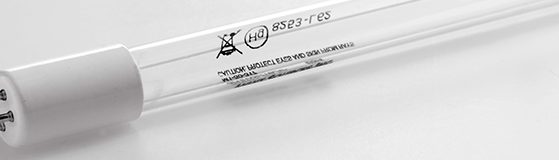
Low-pressure UVC amalgam lamps represent a unique approach to UV curing, leveraging the efficiency of low-pressure mercury technology for curing applications that can utilize UVC light. A low-pressure lamp operates at near-vacuum mercury vapor pressure (around a few microamps), which causes it to emit predominantly the 254 nm UVC line (and 185 nm if using ozone-generating quartz).
Traditionally, as mentioned, such lamps were used for germicidal purposes – disinfecting air and water – rather than curing, because most conventional UV-curable materials needed UVA light. However, with the development of cationic photoinitiators and specific radical photoinitiators that absorb in the UVC range, low-pressure lamps have found a niche in curing.
The term “amalgam” refers to the use of a mercury alloy (typically a mercury-indium or mercury-bismuth mixture) that is placed in the lamp. The amalgam controls mercury vapor pressure over a wider temperature range, allowing the lamp to be driven at higher power inputs without the vapor pressure becoming excessive (which would otherwise quench UV output). In practice, an amalgam lamp can run at much higher wattage than a standard low-pressure lamp; hence, the term Low-Pressure High-Output (LPHO) is often used for amalgam lamps.
Low-Pressure Amalgam Curing Lamps: Performance and Advantages
LightSources’ low-pressure amalgam curing lamps can deliver 300-1000+ W of UV per lamp, a remarkable achievement given that a typical low-pressure lamp of similar size might deliver only ~100 W. They achieve this while still maintaining the monochromatic 254 nm output as the dominant wavelength. About 30–35% of the input power is converted to UVC, which is a high efficiency relative to other lamp types.
One of the key advantages here is that the optimal wall temperature for an amalgam lamp (where it emits maximum UVC) is around 100–120 °C for pellet amalgams, which is much lower than that of medium-pressure lamps (which have wall temperatures of 600–900 °C). This means the lamp can be placed closer to heat-sensitive substrates without risk of damage, and it simplifies cooling requirements (often, ambient air cooling or modest forced-air is sufficient). Additionally, because it doesn’t radiate significant UVA or visible light, the chance of unwanted heating or curing outside the target area is reduced.
Curing of Cationic Inks: The rise of UV-curable cationic inks and coatings has driven the adoption of low-pressure UVC lamps for curing. Cationic systems (often based on cycloaliphatic epoxies or vinyl ethers with sulfonium salt photoinitiators) have some distinct advantages: they are not inhibited by oxygen (unlike radical systems), and they continue curing even after the UV is turned off (the polymerization is driven to completion by the generated acid). These properties can yield higher quality coatings (no oxygen-inhibition tackiness and potentially stronger crosslinking). However, many cationic photoinitiators absorb firmly below 300 nm, making a UVC source highly effective for kick-starting the reaction.
Our low-pressure amalgam lamps, emitting at 254 nm, are ideally suited to this task. They provide a flood of UVC that penetrates the ink or coating layer; even though 254 nm doesn’t penetrate as deeply as UVA (because many materials can absorb it), it is highly effective at initiating the cationic cure on the surface and near-surface, which then propagates through the rest of the material. For applications such as printing on plastics or metals, where cationic inks are used to improve adhesion or chemical resistance, a bank of low-pressure UVC lamps can cure the ink without the high heat of medium/high-pressure lamps, reducing substrate warpage and energy consumption. These lamps also ensure there are no VOC emissions or solvent evaporation, aligning with environmentally friendly manufacturing goals.
System Considerations: A low-pressure UVC curing system typically consists of multiple long amalgam lamps arranged over a conveyor or process area. Because each lamp is long and low-intensity compared to a point-source arc lamp, they provide very uniform illumination over a large area. Engineers often take advantage of this to achieve even curing across wide substrates (for instance, curing a wide web in roll-to-roll manufacturing). With medium- or high-pressure lamps, multiple reflectors and lamps might be needed to cover the width uniformly; with low-pressure lamps, the lamp itself might span the entire width, yielding uniformity by design. The trade-off is usually in curing speed: low-pressure systems may require a slightly longer exposure time (perhaps a few seconds rather than fractions of a second) because the intensity (in W/cm²) is lower. However, because cationic systems continue to cure after exposure, even a short exposure to UVC can be enough to ensure the reaction goes to completion as the product exits the lamp area.
Innovations – Pellet Amalgam: LightSources, together with our European partner LightTech, pioneered the use of pellet amalgam in these lamps. The pellet is a small piece of amalgam that provides a consistent mercury vapor pressure over a broad range of operating conditions. Compared to older spot amalgam (where amalgam was applied as a blob or spot inside the lamp), pellet amalgam allows the lamp to output higher UVC and remain stable even when dimmed or when ambient conditions change. For the end user, this means our lamps can be dimmer-controlled to lower production (for example, if you need to reduce intensity for a thinner coating) and they will still emit a proportionally stable UVC output without “dropping off” into inefficiency. It also means the lamp can start up quickly and reach full output. It can operate in any orientation (horizontal, vertical, etc.) without the amalgam pooling or causing cold spots. In practical terms, you get a highly flexible and robust UVC lamp that adapts to various production scenarios.
LightSources Quality Low-pressure Amalgam Lamp Construction
Low-pressure amalgam lamps from LightSources use high-quality quartz (often synthetic or ozone-free quartz, depending on application). They typically have one or two small amalgam pellets inside, placed in strategic locations to achieve optimal performance (sometimes one near an electrode and one in the center for even mercury distribution). Electrodes are usually coated filaments similar to those in fluorescent lamps, but sized to handle the higher currents of amalgam operation.
The lamps are generally large in diameter (to accommodate the pellets physically and to allow higher output). We offer lamps in standard diameters (e.g., T5, T6, T8 sizes) and custom lengths. Endcaps can be anything from four-pin configurations (standard in amalgam lamps) to custom ceramic caps with leads. Our production ensures the lamps are hermetically sealed and filled with the precise argon fill gas and mercury amalgam dosage to meet the specified wattage.
Low-Pressure Amalgam Curing Lamp Applications
To sum up where low-pressure UVC curing lamps shine: they are chosen for energy-efficient, low-heat curing of specialty materials. Think of scenarios like curing a UV-sensitive coating on a temperature-sensitive film – a medium-pressure lamp might overheat it, whereas a low-pressure lamp could cure it gently. Or curing the inner surfaces of a complex shape, where you might wrap a flexible amalgam lamp around or within the part for uniform coverage. They are also used in lab or pilot lines where operators need a safe, easily controlled UV source – since low-pressure lamps can be turned on/off without high-voltage ignitors and don’t pose as intense a UV hazard (though still require shielding for UVC). Many research and development labs use bench-scale curing setups with amalgam lamps to test cationic resin formulations due to their consistent output at 254 nm.
Finally, a noteworthy point: low-pressure UVC lamps can complement other UV systems. Some advanced curing systems use a hybrid approach – for example, using a medium-pressure lamp for surface cure (UVA) and a low-pressure lamp for through-cure (UVC) to ensure a fully cured product. LightSources can assist in designing such hybrid solutions, providing both lamp types tuned to work in concert.
LightSources Low-Pressure Amalgam Curing Lamp Customization and Support
LightSources’ low-pressure UVC amalgam-curing lamps provide an innovative solution for UV-curing challenges where traditional UVA lamps may not be ideal. With their high efficiency, long life, and unique suitability for cationic and specialized applications, these lamps broaden the possibilities of UV curing technology. Whether you are formulating a new cationic ink line or looking to reduce the footprint and energy consumption of your curing system, our team is ready to help integrate the right low-pressure UVC lamp solution, fully customized to your needs and backed by our decades of UV expertise.
LightSources offers MPUV curing lamps, High-Pressure Curing Lamps, and Low-Pressure UVC Amalgam Curing lamps with custom design and engineering to meet your specific requirements.
Learn more about UV Curing, UV Curing Applications, and explore our Educational Resources on UV Curing, including FAQs, Downloadables, and a UV Curing glossary.
All our lamps, from low-pressure amalgam through high-pressure metal halide, are supported by LightSources’ commitment to quality, performance, and customer collaboration, ensuring that you receive cutting-edge UV curing products that drive your operation’s success.
LightSources is a global supplier of high-pressure UV curing lamps, trusted by OEMs for reliable performance and proven durability. Our ISO 9001:2015 certification reflects a commitment to quality in every stage of development. Partner with our expert engineers to create precision-matched UV lamp solutions for your curing system, including low-pressure amalgam curing lamps.
Custom lamps and base designs, as well as private labeling, are available upon request.