



UV TOC reduction uses 185 nm ultraviolet energy from low-pressure mercury lamps to oxidize organic carbon in water, most often as a polishing step in high-purity and advanced water treatment systems. LightSources designs ozone-generating UV lamps that pass 185 nm for OEM UV TOC reduction equipment used in pharmaceutical, microelectronics, laboratory, and water reuse applications.
What is total organic carbon (TOC) in water?
Total organic carbon is a measure of the carbon bound in organic compounds in water. It is a nonspecific indicator: TOC does not identify which compounds are present, but it shows how much organic material a water system is carrying.
Organic carbon can come from source water, natural organic matter, ion-exchange resins, piping and storage materials, process chemicals, and microbial growth. In a high-purity system, a rising TOC reading can point to a problem with pretreatment, resins, membranes, storage, or distribution.
Why does TOC reduction matter in high-purity and reuse water?
TOC reduction matters wherever organic carbon can affect product quality, process yield, or regulatory requirements. TOC control is common in these applications:
- Pharmaceutical purified water and water for injection
- Microelectronics and semiconductor ultrapure water
- Laboratory and analytical water
- Food and beverage process water
- Potable reuse and advanced water treatment
In pharmaceutical water systems, USP <643> sets a TOC limit of 0.50 mg/L (500 ppb) of carbon for bulk Purified Water and Water for Injection. UV TOC reduction can help a system hold TOC below its control limits, but meeting the limit depends on the complete water system and its monitoring program.
Semiconductor and microelectronics ultrapure water systems also depend on TOC control. In those systems, 185 nm UV is typically one polishing step alongside ion exchange, membranes, and degasification.
In potable reuse, TOC serves as a bulk indicator of the organic compounds that remain after treatment. California’s groundwater replenishment regulations set TOC limits for recycled water based on 0.5 mg/L, adjusted for the recycled water contribution. Orange County Water District’s Groundwater Replenishment System pairs reverse osmosis with UV advanced oxidation and monitors reverse osmosis permeate TOC with online analysis. For more on UV in reuse treatment trains, see UV for water reclamation and reuse.
How does UV TOC reduction work?

UV TOC reduction works by using 185 nm photons to split water molecules into hydroxyl radicals, which then oxidize dissolved organic compounds.
The 185 nm process generates hydroxyl radicals from the photolysis of water and provides advanced oxidation without chemical addition. Hydroxyl radicals react with a broad range of organics and break larger molecules into smaller, often ionized compounds that downstream polishing steps can remove.
Some organic molecules also absorb 185 nm or 254 nm energy directly and break apart through photolysis. At 254 nm alone, direct photolysis is limited for many compounds, so 254 nm systems aimed at organics usually add an oxidant such as hydrogen peroxide. That approach is covered in UV advanced oxidation process (UV AOP) lamp solutions.
Where ozone fits
When 185 nm energy passes through air or oxygen around the lamp, it also generates ozone. Ozone-generating lamps can be used deliberately for ozone production, but in a TOC reactor the result depends mainly on the 185 nm energy that reaches the water itself.
What affects UV TOC reduction performance?
UV TOC reduction performance depends on how much 185 nm energy reaches the water and how much of that energy the target organics actually use. Four factors carry most of the weight.
Delivered 185 nm output
A 2025 study co-authored by Dan Spicer of LightSources found wide variation in 185 nm output among low-pressure mercury lamp system configurations. It also showed that 254 nm output is not a good indicator of 185 nm output. Lamp envelope material, sleeve material, the gap between lamp and water, and lamp operating conditions all deserve review during design.
Water chemistry and competing absorbers
Water absorbs 185 nm strongly, so most of the reaction takes place close to the sleeve. Other dissolved constituents compete for the same energy. When chloride exceeds about 20 mg/L, chloride rather than water absorbs most 185 nm photons and changes the radical chemistry. That is one reason 185 nm UV usually follows reverse osmosis or ion exchange, where dissolved ions are already low.
Flow, exposure, and reactor geometry
Residence time, lamp spacing, and mixing determine how much of the water passes close to the sleeve, where 185 nm activity concentrates. Narrow annular gaps and good mixing help, while short-circuiting flow paths reduce the result.
Lamp aging and replacement
185 nm output depends on lamp design and operating conditions across the lamp’s life. Replacement intervals should be set by the TOC result the system has to hold, not by 254 nm sensor readings alone.
Which lamps are used for UV TOC reduction?
UV TOC reduction requires lamps whose envelopes pass 185 nm. LightSources ozone-generating UVC lamps pass 185 nm, while ozone-free lamp options block 185 nm, so lamp selection starts with the envelope material.
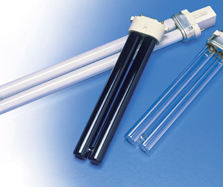
Low-pressure mercury lamps with 185 nm-transmitting quartz are the usual source for UV TOC reduction, and LightSources low-pressure mercury lamps are available in ozone-generating and ozone-free versions. LightSources compact UV lamps are available in quartz for both 185 nm and 254 nm output.
Where reactor size is constrained, LightSources pellet amalgam lamps provide up to 3x the UVC output of comparable standard lamps of the same length. Their 185 nm output still has to be confirmed for the specific lamp and sleeve configuration. LightSources medium-pressure UV lamps, which range from 100 to more than 700 watts per inch, are more often paired with an added oxidant in UV advanced oxidation than used for 185 nm photolysis.
How is UV TOC reduction different from UV disinfection?
UV disinfection inactivates microorganisms, most commonly at 254 nm, while UV TOC reduction oxidizes dissolved organic carbon using 185 nm. Many high-purity systems use both: a 254 nm unit to control microbial growth and a 185 nm unit to polish TOC.
The two are sized differently. Disinfection depends on delivered UVC dose and UV transmittance, while TOC reduction depends on delivered 185 nm energy and water chemistry. For 254 nm reactor design in process and industrial water, see UV disinfection water treatment.
Frequently asked questions

Engineers who design high-purity and reuse water systems often ask the following questions about UV TOC reduction.
Does a 185 nm lamp produce ozone in water treatment equipment?
A 185 nm lamp generates ozone when its output passes through air or oxygen, such as the gap between the lamp and its sleeve. In the water itself, 185 nm mainly photolyzes water to form hydroxyl radicals. Equipment that uses ozone on purpose also has to address ventilation, materials compatibility, and off-gas handling.
Can UV TOC reduction replace reverse osmosis or ion exchange?
No. UV TOC reduction is usually a polishing step for residual organics, and it works best on water that reverse osmosis or ion exchange has already treated. Downstream ion exchange often removes the ionized byproducts that UV oxidation creates, so the steps work together.
Can a 254 nm UV sensor confirm 185 nm TOC lamp performance?
Not reliably. Research co-authored by LightSources’ Dan Spicer found that 254 nm output is not a good indicator of 185 nm output in low-pressure mercury lamp systems. A TOC analyzer on the treated water gives the direct measure of performance.
What TOC level does a UV system need to reach?
The target comes from the application. Pharmaceutical bulk water must meet the USP <643> limit of 0.50 mg/L of carbon, potable reuse projects follow their state requirements, and semiconductor fabs set their own ultrapure water specifications. The UV system is sized to help the complete treatment train hold that target.
How does LightSources support UV TOC reduction OEMs?
LightSources supports OEMs by co-engineering 185 nm and 254 nm lamps around the final reactor, power architecture, and service plan. Programs cover envelope material, arc length, power, sleeve fit, ballast compatibility, prototyping, production, and long-term replacement supply.
For more engineering and application detail, review these LightSources resources:
- OEM UV lamp engineering partner for design-stage collaboration and lifecycle supply.
- UV lamp engineering capabilities for custom geometry, electrical, and thermal integration.
- UV water purification for lamp selection across drinking, process, and reuse water.
Talk to Our Engineering Team to review 185 nm output, envelope and sleeve materials, reactor fit, and replacement planning for TOC reduction equipment.
UV lamps for TOC reduction in water
Effective UV TOC reduction depends on delivering 185 nm energy to clean, low-ion water in a reactor designed for the organic load. Matching the lamp envelope, sleeve, output, and replacement plan to the system target helps OEM equipment hold TOC where the application requires it.
LAMP PRODUCT DATA:
LAMP APPLICATIONS:
LightSources engineers UV lamps around the spectral, electrical, thermal, and lifecycle requirements of OEM water-treatment equipment, including 185 nm lamps for TOC reduction. ISO 9001:2015 certified manufacturing, custom lamp development, and rapid prototype support carry programs from prototype through production and replacement supply. Contact Us to learn more about LightSources lamps for UV TOC reduction.

This post is also available in:
 Vereinfachtes Chinesisch
 Spanisch