

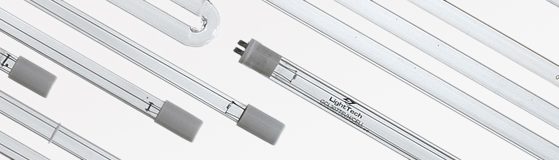
LightSources and strategic partner, LightTech manufacture a low pressure mercury lamp (LP Hg lamp) that provides highly efficient short wavelength ultraviolet energy. Our LP Hg lamp converts about 40% of the electrical power into UVC radiation at 254 nm for germicidal applications. With our proprietary LongLife+™ coating process, the low pressure mercury lamps have an operating life of up to 16,000 hours, maintaining an end-of-life UVC output of 80%.*
Our low pressure mercury lamp technologies offer clients a wide range of solutions. Various technologies include soft glass and quartz glass, ozone free and ozone generating lamps, standard and high output lamps, low-pressure amalgam lamps, and specialty lamps. We offer both standard and customized products, and work closely with our OEM’s to create innovative, proprietary lamp types and components.
* Life claim testing done under laboratory conditions. Actual performances depend on operating conditions.
Low Pressure Mercury Lamp – Learn What Goes Into Ours
Soft Glass vs. Quartz Glass
Softglass lamps are one of our quality low pressure mercury lamp products. They have a germicidal efficiency of 30% and can operate on lower current (between 180 and 425mA). The lamps come in both standard and high-output selections and are ozone-free.
Our quartz glass lamps are designed to be highly UVC transmissive, with transmission levels at or above 90%. Operating at 253.7nm, they are very close to the peak germicidal effectiveness curve of 265nm. They come in a standard or high output, offering both ozone free and ozone generating solutions. Quartz glass is more resistant to solarization, a by-product of UV lamp operation. Quartz is also harder than soft glass and less susceptible to breakage.
Ozone Free vs. Ozone Generating Lamps
Ozone-free lamps are used for simple disinfection applications and only require a wavelength of 254nm. This wavelength can also be used in ozone destruction. Ozone-free lamps are engineered using doped quartz.
Ozone is a strong oxidizing agent, reacting with a multitude of organic compounds to oxidize and disinfect air and water. Ozone is a highly-efficient deodorizer and can help to disinfect locations from surface and airborne mold and bacteria. Ozone-generating lamps are available in two varieties: “H” (High Output-ozone generating) and “VH” (Very High ozone generating).
Standard vs. High Output
Another low pressure mercury lamp option is our standard and high-output (HO) UVC lamps that use mercury vapor to emit UVC light. Liquid mercury droplets collect at the lamp’s “cold spot.” Once the mercury droplets reach their peak temperature, maximum UVC output occurs.
High-output lamps are driven at a higher electrical current and input wattage (operating at 600mA and 800mA vs. 425mA), are equipped with heavier current carrying filaments, and are capable of carrying higher electrical loads. The filaments used in HO lamps provide a more controlled cold spot, enabling them to yield up to 66% more UV output than standard lamps of the same length.
HO UVC lamps are used in applications where higher flow rates or dosages are required while maintaining a limited footprint. Standard UVC lamps are used in applications where flow rates are lower and exposure times can be longer.
Low-Pressure Amalgam Lamps
Amalgam lamps use a mercury amalgam mix to control mercury vapor pressure. Rather than a “cold spot,” the lamp’s “amalgam spot on pellet” regulates mercury vapor pressure during operation and yields up to 3x the UV-C output of comparable standard lamps of the same length. We offer a variety of amalgam lamp solutions.
Specialty Lamps
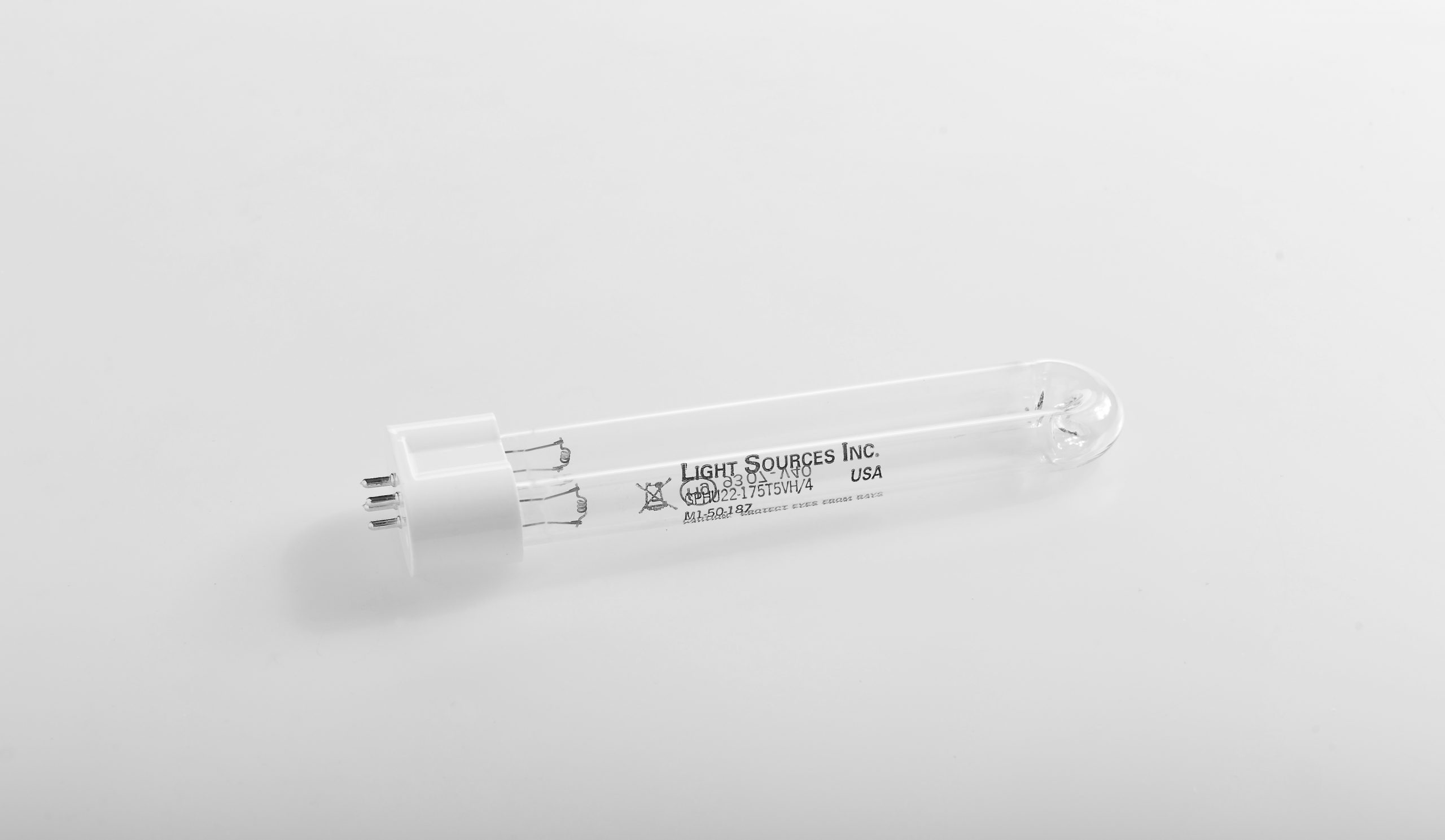
Our specialty lamp solutions include Quartz Germipak Cell Lamps, Quartz U-Lamps, Quartz Compact Lamps, and Soft Glass Compact Lamps.
Engineers comparing standard-output, high-output, compact, ozone-generating, and specialty configurations can use LightSources’ technical resources for OEM UV lamp engineering.
How do low-pressure and medium-pressure UV lamps differ?
Low-pressure mercury lamps put most of their UV energy into a single line at 254 nm, close to the peak of germicidal effectiveness. Medium-pressure lamps run at much higher pressure and temperature and emit a broad UV spectrum, with far more power from each lamp but a lower share of it in the germicidal range. Low-pressure amalgam lamps keep the 254 nm line of a standard low-pressure lamp and raise the output per lamp, for systems that need more UVC from fewer lamps.
| Characteristic | Low-pressure quartz | Low-pressure soft glass | Low-pressure amalgam | Medium-pressure |
|---|---|---|---|---|
| UV output | UVC 254 nm (185 nm ozone option) | UVC 254 nm | UVC 254 nm (185 nm ozone option) | Broad UV spectrum |
| Mercury operating temperature | 30 to 50 °C | 30 to 50 °C | 90 to 120 °C | 600 to 800 °C |
| Germicidal efficiency (200 to 300 nm) | 30% to 40% | 30% | 30% to 35% | 12% to 16% |
| Power density | 0.3 to 0.5 W/cm | 0.25 to 0.3 W/cm | 1.0 to 2.0 W/cm | 50 to 250 W/cm |
| Effect of surrounding temperature | High | Very high | Low | Negligible |
Source: LightSources General FAQs.
Low-pressure lamps are the usual choice for drinking water units, HVAC coils, cabinets, and surface systems, where the lamp can run near its best temperature. Medium-pressure lamps are used in large municipal water and wastewater plants, where a few high-power lamps take the place of many low-pressure lamps. Related lamp pages: medium-pressure UV lamps, low pressure amalgam lamps.
What should OEMs consider when choosing a low-pressure mercury lamp?
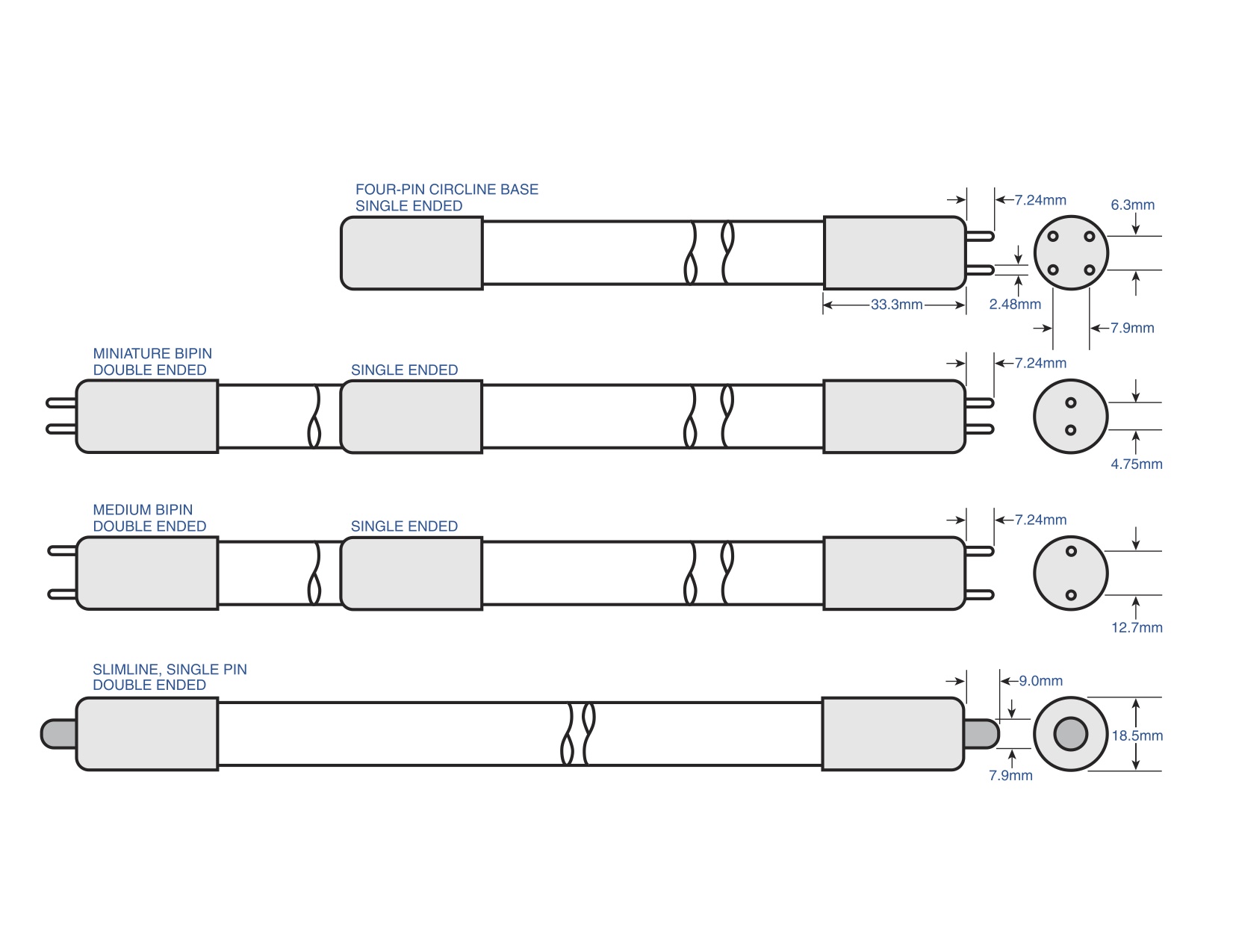
OEMs choosing a low-pressure mercury lamp should match the glass, current, ozone option, and starting circuit to how the system will run:
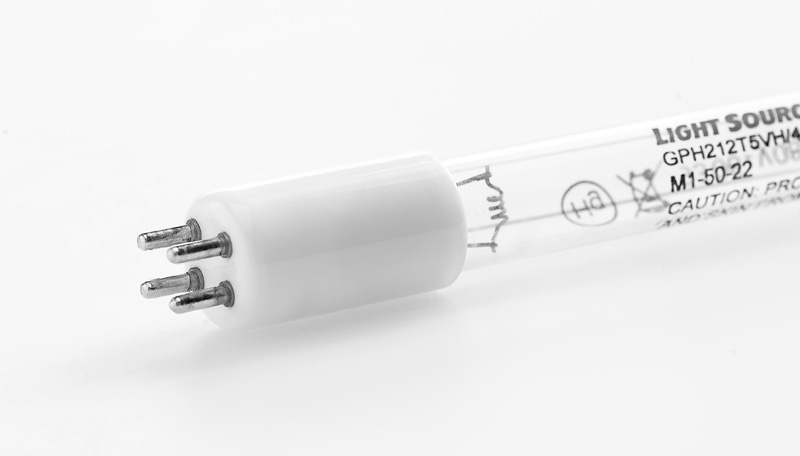
- Glass: soft-glass lamps run at 180 to 425 mA and are ozone-free. Quartz lamps transmit 90% or more of UVC and come in ozone-free and ozone-generating versions.
- Current and output: standard lamps run at about 425 mA. High-output quartz lamps run at 600 to 800 mA and give up to 66% more UV output than standard lamps of the same length. Amalgam lamps run from 1 to 10 A.
- Ozone: ozone-free lamps use doped quartz that blocks 185 nm. Ozone-generating lamps pass 185 nm for systems that use ozone to treat air or water.
- Starting circuit: instant-start lamps light with no filament heating but do not handle frequent switching. Preheat circuits cost more but are needed for systems that cycle on and off many times.
- Ballast: the ballast must match the lamp current. Electronic ballasts use less power; electromagnetic ballasts cost less.
- Temperature: standard and soft-glass lamps lose output when the air or water around them is much colder or hotter than their design point. Amalgam lamps hold output from 4 °C to 40 °C.
- Mercury content: liquid-mercury lamps hold 20 to 100 mg of mercury. Pellet designs hold less than 10 mg (General FAQs).
- Sleeves: in water systems, lamps run inside UV quartz sleeves, and sleeve fouling reduces delivered UVC.
How does LightSources work with OEMs on low-pressure lamp designs?
LightSources and LightTech build standard and custom low-pressure mercury lamps for OEMs of water, air, and surface disinfection systems, matching glass, length, current, base, and ozone option to each design. LightSources builds custom lamps through its OEM custom lamp design and Rapid Prototype Program under an ISO 9001:2015 registered quality system. Talk to Our Engineering Team about low-pressure lamps for your next system.
Frequently asked questions
These answers cover common questions about low pressure mercury lamps.
How long do low-pressure mercury lamps last?
LightSources low-pressure mercury lamps with LongLife+ coating run up to 16,000 hours and keep 80% of their UVC output at end of life, based on laboratory testing. Actual life depends on lamp current, temperature, and how often the lamp is switched on and off. Many systems replace lamps on a schedule, at least once a year in continuous use, because UVC output drops before a lamp stops lighting. See the general FAQs on lamp replacement.
What are the trade-offs between instant-start and preheat lamp circuits?
Instant-start circuits light the lamp right away with no filament heating, but they need a higher starting voltage and shorten lamp life when the lamp is switched often. Rapid-start circuits add a short 1 to 2 second preheat at low cost. Preheat circuits heat the filaments for as long as needed before the lamp starts; they cost more, but systems that cycle on and off many times need them. See the general FAQs.
Should an OEM use an electronic or an electromagnetic ballast?
It depends on cost and size limits. Electronic ballasts use less power, run about 10% more efficiently, weigh less, and have no lamp voltage limitation, but they cost more. Electromagnetic ballasts cost less and are reliable, but they use more power and take more space. LightSources and LightTech offer electronic ballasts for their UVC germicidal lamps. See the general FAQs.
Can UV-C LEDs replace low-pressure mercury lamps?
Not in most high-output systems yet. LightSources low-pressure mercury lamps convert about 40% of electrical power to UVC at 254 nm, while UV-C LEDs convert about 3% to 10% (LEDs Magazine via Buildings). LEDs start instantly and handle frequent switching, so they have found uses in point-of-use and some drinking water units, but their wall-plug efficiency is improving slowly (Rauch et al., 2024).
How does 254 nm UVC differ from far-UVC at 222 nm?
Both inactivate bacteria and viruses, but they come from different lamps and are used in different places. Low-pressure mercury lamps emit UVC at 254 nm, which can harm skin and eyes, so 254 nm systems are shielded or used where people are not exposed, such as upper-room air, HVAC ducts, and closed water reactors. Far-UVC at about 222 nm comes from filtered excimer lamps and penetrates skin and eyes far less, so it is being studied for use in occupied rooms within exposure limits (Welch et al., 2022).
References
- LightSources. General FAQs. light-sources.com
- Rauch, K. D., et al. (2024). A critical review of ultra-violet light emitting diodes as a one water disinfection technology. Water Research X, 25, 100271. pmc.ncbi.nlm.nih.gov
- LEDs Magazine. GUV systems: Rethinking wall plug efficiency for UV-C LEDs in water disinfection. Republished by Buildings. buildings.com
- Welch, D., et al. (2022). Wavelength-dependent DNA photodamage in a 3-D human skin model over the far-UVC and germicidal UVC wavelength ranges from 215 to 255 nm. Photochemistry and Photobiology. pmc.ncbi.nlm.nih.gov
LAMP PRODUCT DATA:
LAMP APPLICATIONS:
LightSources and LightTech design and manufacture low pressure mercury lamps in soft glass and quartz, in ozone-free and ozone-generating versions, and in standard and high-output models for OEMs that build water, air, and surface disinfection systems. LightSources lamps are made under an ISO 9001:2015 registered quality system. Contact Us to learn more about LightSources low pressure mercury lamps.
This post is also available in:
 Chinese (Simplified)