

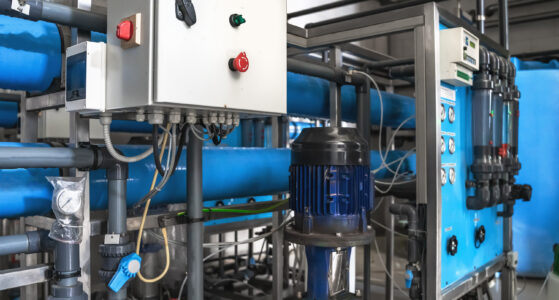
UV water treatment systems use germicidal UVC to reduce susceptible microorganisms as water moves through a treatment chamber or reactor. Most conventional systems use UVC at or near 254 nm, a wavelength widely used in drinking water, industrial process water, aquaculture, wastewater, water reuse, and other applications.
UV is often described as an eco-friendly water-treatment option because UV disinfection does not require adding a disinfectant chemical to the water. It can reduce chemical handling and avoid introducing a chemical disinfectant taste or odor during the UV treatment stage. The environmental profile of the complete system still depends on factors such as energy use, lamp life, pretreatment, maintenance, and disposal practices.
For a broader technical overview of dose, reactor design, lamp selection, pretreatment, and validation, explore LightSources’ UV Water Purification guidance.
How Do UV Water Treatment Systems Work?
UV water treatment systems work by exposing microorganisms in the water to a controlled amount of germicidal ultraviolet radiation. UVC energy damages microbial nucleic acids and interferes with the organism’s ability to reproduce.
In a typical reactor, water flows past one or more UV lamps protected by quartz sleeves. The sleeve keeps the lamp separated from the water while allowing UVC to pass into the treatment zone. The NCBI Bookshelf chapter on aquatic housing systems describes this arrangement and notes that lamp intensity, UV transmittance, exposure time, target organisms, sleeve cleanliness, and lamp condition all affect performance.
The lamp supplies the UVC output, but the complete system determines how that energy reaches the moving water. Flow rate, UV transmittance, chamber geometry, lamp position, hydraulics, quartz condition, sensors, controls, and maintenance all affect the exposure delivered through the reactor.

For a closer look at how these variables work together, read Understanding UV Water Disinfection.
What Determines UV Dose in Water Treatment?
UV dose starts with a simple relationship between irradiance and exposure time:
| UV Dose = Irradiance × Exposure Time | D = E × t |
In a flowing reactor, however, water does not travel through one uniform path. Different portions of the flow may receive different levels of UVC exposure, and suspended solids, color, dissolved material, or fouling can reduce the amount of UVC that reaches microorganisms.
That is why reactor design has to account for dose distribution across the intended operating range, not just an average theoretical value. Important variables include design and peak flow, minimum expected UV transmittance, lamp output over operating life, quartz-sleeve transmission, fouling, reactor dimensions, lamp spacing, inlet and outlet geometry, water temperature, sensors, controls, and the validation method used for the complete reactor.
The U.S. Environmental Protection Agency’s UV Treatment Toolkit treats design review, hydraulics, validation, instrumentation, operating conditions, lamp aging, sleeve fouling, and UV sensor performance as connected parts of long-term reactor performance.
Benefits of UV Water Treatment Systems
Disinfection Without Adding a Chemical at the UV Stage
UV provides a physical disinfection step. Unlike chlorination, the UV exposure itself does not require a disinfectant chemical to be dosed into the water.
That can be useful where chemical storage, handling, taste, odor, corrosion, or downstream process compatibility are concerns. It does not mean every water-treatment system can operate without chemicals. Pretreatment, oxidation, residual disinfection, pH adjustment, or other processes may still be needed depending on the application.
Treatment of a Range of Waterborne Microorganisms
Properly designed UV systems can inactivate susceptible bacteria, viruses, protozoa, and other microorganisms that pass through the reactor at an appropriate dose.
UV has particular value in drinking-water treatment because microorganisms do not all respond the same way to different disinfectants. The U.S. Environmental Protection Agency’s Ultraviolet Disinfection Guidance Manual provides detailed guidance on UV dose response, reactor validation, monitoring, lamp aging, fouling, water quality, and operating conditions for public drinking-water systems.
Any treatment claim should be based on the performance and validation of the complete UV system, not the lamp by itself.
Continuous Treatment for Flowing Water
UV can be incorporated into continuous-flow equipment ranging from compact point-of-entry units to municipal reactors and industrial water-treatment systems.
The design changes with the application. A residential unit treating a relatively low flow does not have the same lamp, hydraulic, monitoring, or validation requirements as a municipal reactor, wastewater channel, aquaculture loop, or ballast-water treatment system.
No Downstream Disinfectant Residual From the UV Step
Conventional UVC treatment does not normally leave a continuing disinfectant residual after the water exits the UV chamber. That can be desirable where chemical residuals are unwanted, but drinking-water distribution and some reuse applications may still require another barrier or residual protection downstream.
Where Are UV Water Treatment Systems Used?
UV water treatment is used across applications with very different water quality, flow rates, microbial targets, operating environments, and regulatory requirements.
Drinking Water
UV drinking-water systems are used in residential point-of-entry equipment, commercial systems, small-community installations, and municipal treatment facilities. Equipment must be designed around actual flow, UV transmittance, pretreatment, required microbial reduction, monitoring, and any applicable validation or certification requirements.
For residential treatment equipment, NSF guidance on NSF/ANSI 55 ultraviolet treatment systems distinguishes between Class A systems for contaminated water and Class B systems intended to reduce non-disease-causing bacteria in disinfected drinking water. Certification applies to the complete treatment system, not simply to the UVC lamp installed inside it.
Learn more about UV drinking-water disinfection for residential, community, and municipal applications.
Aquariums and Aquaculture
Aquarium and aquaculture systems use UVC to reduce susceptible microorganisms in circulating water used in commercial aquariums, recirculating aquaculture systems (RAS), hatcheries, fish farms, and research facilities.
Water clarity matters in these systems. Suspended material can absorb or scatter UVC and shield microorganisms from exposure, so filtration and solids control are closely tied to UV performance. A 2023 review of disinfection methods in recirculating aquaculture systems identifies UV and ozone as commonly used RAS disinfection approaches and discusses how operating conditions affect system stability.
For application-specific guidance on flow, filtration, biofiltration, RAS placement, ozone integration, and lamp selection, explore UV light for aquariums and aquaculture.
Industrial Process Water
Industrial UV systems can treat process water, recirculating water, high-purity water, and water used in technical manufacturing operations. These systems may have to accommodate continuous-duty operation, variable flow, changing water chemistry, temperature limits, compact equipment footprints, or integration with filtration, reverse osmosis, oxidation, and other treatment stages.
Explore industrial UV disinfection water treatment for additional application guidance.
Wastewater Treatment
Municipal and industrial wastewater can present suspended solids, variable flow, lower UV transmittance, and greater fouling potential. Effective pretreatment and hydraulic design are important because particles can shield microorganisms from UVC exposure.
Lamp spacing, quartz-sleeve cleaning, flow distribution, monitoring, and maintenance must be evaluated based on expected wastewater conditions. Learn more about wastewater UV treatment applications.
Water Reclamation and Reuse
Reclaimed-water systems can use UV as one step in treatment trains designed around the source water and intended end use. Irrigation, industrial reuse, cooling water, non-potable municipal reuse, and potable-reuse processes can require different levels of pretreatment, monitoring, disinfection, and validation.
See LightSources’ water reclamation and reuse resource for more on these applications.
Pools and Spas
Pool and spa UV equipment treats recirculating recreational water as part of a broader water-management program that also includes filtration and chemical treatment. High circulation rates, water chemistry, continuous operation, quartz fouling, temperature, and service access can all affect lamp and equipment requirements.
Explore UV treatment for pools and spas.
Ballast Water Treatment
UV is also used within marine ballast-water management systems designed to reduce the transfer of aquatic organisms between ports and ecosystems. These systems add engineering considerations such as high flow, changing UV transmittance, salinity, vibration, corrosion exposure, power requirements, and limited service space.
The International Maritime Organization’s guidance on ballast-water treatment technologies explains that ballast-water management systems used to comply with the BWM Convention are subject to testing and type-approval procedures for the complete system.
LightSources provides UVC lamp engineering and manufacturing support for ballast-water treatment systems.

Which UVC Lamps Are Used in UV Water Treatment Systems?
Different UV water treatment systems call for different lamp technologies. The right choice depends on the required output, flow, reactor footprint, electrical design, operating temperature, water conditions, maintenance strategy, and treatment objective.
Low-Pressure Mercury Lamps
LightSources low-pressure mercury lamps are widely used where efficient 254 nm output fits the required reactor dimensions and lamp count. LightSources low-pressure mercury lamps convert about 40% of electrical power to UVC at 254 nm for germicidal applications.
The final dose delivered to the water still depends on the complete reactor, including flow, UV transmittance, geometry, quartz transmission, lamp condition, and hydraulics.
Low-Pressure Amalgam Lamps
Higher-output low-pressure amalgam lamps can support equipment that needs more UVC output within a defined footprint. LightSources pellet amalgam lamps provide up to 3x the UVC output of comparable standard lamps of the same length.
That additional output can support higher treatment capacity or a lower lamp count in some equipment designs, but it does not automatically produce 3x the delivered dose in the final reactor.
Medium-Pressure UV Lamps
LightSources medium-pressure UV lamps provide much higher power density and broader spectral output than conventional low-pressure lamps. LightSources medium-pressure UV lamps range from 100 to more than 700 W/in. Use requires coordinated review of heat load, cooling, electrical requirements, quartz conditions, chamber dimensions, controls, and maintenance access.
LightSources offers UVC germicidal lamps for water-treatment equipment in standard and custom configurations.
How the UV Lamp Fits Into the Complete Water-Treatment System
Lamp output matters, but water-treatment performance comes from the way the lamp is integrated into the complete reactor. The lamp does not establish the flow profile, UV transmittance, chamber geometry, fouling condition, sensor response, validation envelope, or maintenance program.
That distinction is important during equipment development. A lamp can produce the expected UVC output and still be part of a system that underperforms if water moves too quickly, UV transmittance drops, quartz sleeves become fouled, or the reactor creates weak exposure paths.
For engineers evaluating those relationships, LightSources’ UV Water Purification resource covers dose, UV transmittance, reactor design, pretreatment, lamp technology, validation, and application-specific considerations in greater depth.
Maintenance and Long-Term UV Performance
UV water treatment is not maintenance-free. Lamp output changes over operating life, and deposits can build up on quartz sleeves and sensor windows. Water chemistry, minerals, biological growth, temperature, flow changes, and operating conditions can all affect how quickly service is required.
A practical maintenance program may include lamp inspection and replacement, quartz-sleeve cleaning, sensor checks, operating-hour review, alarm response, and confirmation that flow and water quality remain within the equipment’s intended operating range.
EPA drinking-water guidance addresses lamp aging, sleeve fouling, UV sensors, UV transmittance monitoring, cleaning systems, and operating conditions as part of long-term UV performance.
OEM UV Lamp Engineering for Water Treatment Systems
For equipment manufacturers, lamp selection for UV water treatment systems is most useful when it begins with the requirements of the complete water-treatment system. Flow, target dose, UV transmittance, reactor dimensions, lamp orientation, water temperature, ballast architecture, quartz-sleeve configuration, electrical interfaces, maintenance access, validation requirements, and expected service life can all affect the final lamp specification.
LightSources works with equipment manufacturers through an OEM UV lamp engineering partnership that can support lamp selection, custom geometry, ballast and quartz integration, prototype development, controlled manufacturing, production scale-up, and long-term replacement supply.
LightSources supports OEM programs through ISO 9001:2015 registered manufacturing, custom UV lamp design, and Rapid Prototype Programs. The goal is to align the lamp with the equipment’s mechanical, electrical, optical, thermal, and lifecycle requirements from development through production.
Frequently Asked Questions About UV Water Treatment Systems
How do UV water treatment systems disinfect water?
UV systems expose waterborne microorganisms to germicidal ultraviolet radiation as water passes through a treatment chamber. Performance depends on delivered dose, flow, UV transmittance, reactor geometry, lamp output, hydraulic conditions, and maintenance.
What wavelength is commonly used for UV water treatment?
UVC at approximately 254 nm is widely used in conventional UV water-disinfection systems. LightSources low-pressure mercury lamps convert about 40% of electrical power to UVC at 254 nm for germicidal applications.
Does UV water treatment replace filtration?
No. Filtration and UV do different jobs. Filtration removes particles and other material that can reduce UV transmittance or shield microorganisms, while UV treats susceptible microorganisms that pass through the radiation field.
Does a higher-wattage UV lamp always provide better disinfection?

No. Lamp output is only one part of treatment performance. Flow rate, UV transmittance, chamber geometry, lamp placement, quartz-sleeve condition, hydraulic distribution, sensors, controls, and validation all influence the dose delivered by the complete system.
How often do UV lamps and quartz sleeves need maintenance?
Maintenance intervals depend on the lamp, water quality, operating conditions, quartz fouling, equipment design, and manufacturer requirements. OEM documentation should define lamp replacement, sleeve cleaning, sensor checks, alarm response, and other service procedures for the specific system.
Can UV be used with other water-treatment methods?
Yes. UV is commonly integrated with filtration and can also be used in treatment trains that include reverse osmosis, biological treatment, chemical disinfection, oxidation, ozone, activated carbon, or other processes. The right combination depends on water quality, treatment objectives, and the requirements of the final application.
UVC Lamps for UV Water Treatment Systems
Reliable UV water treatment starts with matching the lamp to the reactor, water quality, flow, controls, maintenance strategy, and treatment objective. LightSources engineers standard and custom UVC lamps for OEM water-treatment equipment ranging from compact drinking-water units to industrial, aquaculture, wastewater, reuse, and marine applications.
LAMP PRODUCT DATA:
UV Germicidal LampsLAMP APPLICATIONS:
UV Germicidal Applications
LightSources engineers UVC lamps around the electrical, thermal, optical, mechanical, and lifecycle requirements of OEM water-treatment equipment. Standard and custom lamp development supports programs from prototype through production and long-term replacement supply. Contact LightSources to discuss UVC lamp requirements for UV water treatment systems.

This post is also available in:
 Vereinfachtes Chinesisch
 Spanisch