
UV drinking water disinfection uses germicidal UVC radiation, most commonly at 254 nm, to inactivate target microorganisms as water passes through a properly designed treatment system. LightSources engineers UVC lamps for OEM drinking-water equipment used in residential, small-community, municipal, and commercial applications. Lamp selection is coordinated with flow, UV transmittance, dose requirements, reactor geometry, electrical integration, and operating conditions.
UV provides a physical disinfection step without adding a disinfectant chemical at the point of UV exposure. Final performance depends on the complete drinking water UV system, including pretreatment, lamp output, quartz-sleeve condition, hydraulics, sensors, controls, maintenance, and operation within validated conditions.
What Is UV Drinking Water Disinfection?
UV drinking water disinfection is a physical treatment process that exposes waterborne microorganisms to germicidal UVC energy so they can no longer replicate effectively.
The process can inactivate bacteria, viruses, and protozoa without adding chlorine or another disinfectant chemical at the UV stage. The EPA Ultraviolet Disinfection Guidance Manual addresses microbial response, reactor validation, operating conditions, monitoring, and dose delivery for drinking-water UV systems.
UV treatment does not remove dissolved salts, metals, or most chemical contaminants, and it does not normally leave a disinfectant residual after treatment. For many applications, UVC drinking water disinfection is one barrier within a broader treatment train that may also include filtration, chemical disinfection, storage, and distribution controls.

How UV Drinking Water Disinfection Works
UV drinking water disinfection works by delivering enough UVC irradiance for enough exposure time to achieve the required microbial inactivation under defined flow and water-quality conditions.
Low-pressure mercury lamps used in drinking-water equipment emit primarily at UVC 254 nm. The lamp is typically isolated from the water by a quartz sleeve, while the reactor directs water through the radiation field. Flow rate, UV transmittance, lamp position, sleeve transmission, inlet hydraulics, sensor response, and lamp aging all affect the dose the water receives.
A higher-wattage lamp does not automatically deliver a higher validated dose throughout the reactor. Dose distribution depends on how the lamp and reactor work together across the full operating range. For a broader explanation of these relationships, read Understanding UV Water Disinfection for additional engineering guidance across multiple water-treatment applications.
UV Lamp Technologies for Drinking Water Systems
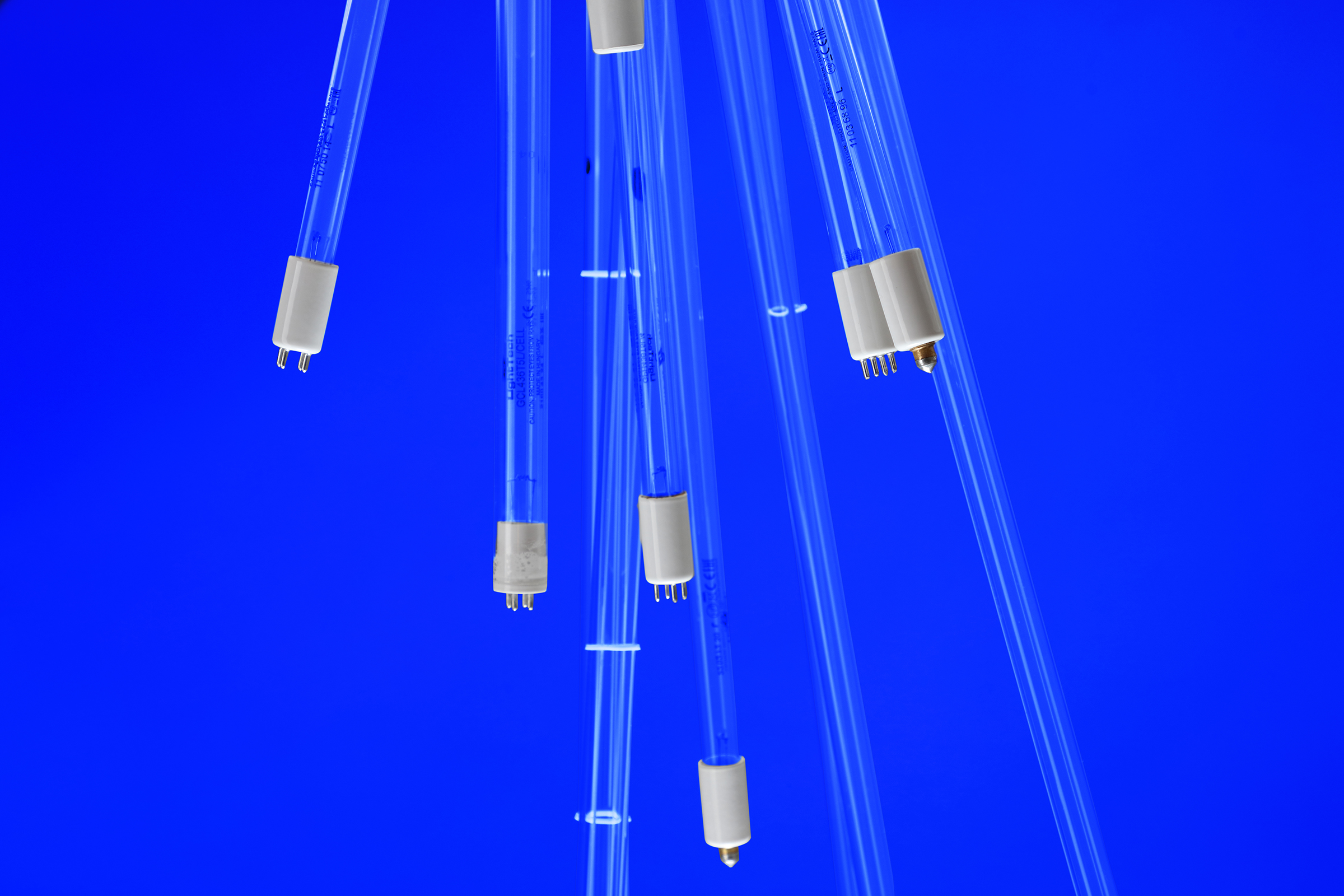
UV lamps for drinking water equipment commonly include low-pressure mercury, low-pressure amalgam, and medium-pressure technologies. The correct lamp technology depends on the required treatment capacity, reactor footprint, flow, water temperature, electrical architecture, service access, and validation strategy. LightSources’ UV lamp engineers can help you choose the most effective lamp type for your UV water disinfection system.
UVC 254 nm for Microbial Control
LightSources low-pressure mercury lamps convert about 40% of electrical power to UVC at 254 nm. This wavelength is widely used in UV drinking water treatment because it provides a defined germicidal output that can be incorporated into validated low-pressure and amalgam lamp systems.
The wavelength alone does not establish the treatment claim. The complete UV water disinfection system must still deliver the required dose throughout its validated flow and water-quality range.
Ozone 185 nm for Specialized Water Treatment
LightSources ozone-generating lamp options pass 185 nm, while ozone-free options block 185 nm. The 185 nm wavelength may be used when ozone generation, total organic carbon reduction, or another photochemical process is intentionally part of the treatment train.
These applications require separate evaluation of process chemistry, materials, ventilation, oxidation byproducts, monitoring, and downstream treatment. They should not be treated as interchangeable with standard 254 nm microbial disinfection.
Far-UVC 222 nm in Emerging Research
Far-UVC 222 nm is not the standard lamp technology used in current drinking-water disinfection systems. It may appear in emerging research or specialized photochemical work, but current drinking-water equipment primarily relies on established low-pressure, amalgam, and medium-pressure UV technologies matched to the complete reactor design.
Low-Pressure Mercury Lamps
LightSources low-pressure mercury lamps are used in point-of-entry, small-community, process-water, and multi-lamp reactor designs where efficient 254 nm output and available lamp length fit the equipment architecture. Their lower power density can support efficient systems when the reactor has sufficient space for the required lamp quantity and exposure path.
Low-Pressure Amalgam Lamps
LightSources low-pressure amalgam lamps provide up to 3x the UVC output of comparable standard lamps of the same length. Higher output can help an OEM support greater treatment capacity or reduce lamp count within a defined footprint, but it does not independently produce 3x the validated reactor dose.
Flow, UV transmittance, hydraulic distribution, lamp placement, quartz-sleeve condition, sensors, and operating limits still determine how much UVC exposure the water receives.
Medium-Pressure UV Lamps
LightSources medium-pressure UV lamps range from 100 to more than 700 watts per inch and can provide high power density for compact or high-flow equipment. The reactor design must account for electrical demand, heat load, cooling, quartz protection, ballast integration, service access, and the operating envelope used for validation.
Drinking Water Treatment Performance and Design
UV drinking water treatment performance depends on the complete treatment system, not lamp wavelength or wattage alone. Water quality, hydraulic conditions, pretreatment, reactor validation, monitoring, and maintenance all influence the dose available for microbial inactivation.
Effectiveness Against Waterborne Pathogens
UV can provide drinking-water treatment credit against bacteria, viruses, and protozoa when the reactor delivers the required validated dose for the target organism.
Different microorganisms have different UV sensitivities, so an equipment claim should be tied to the applicable dose, log-inactivation target, validation method, and regulatory framework. UV is particularly useful in surface-water treatment because organisms such as Cryptosporidium can be resistant to commonly used chlorine disinfection.
The EPA’s Long Term 2 Enhanced Surface Water Treatment Rule resources address Cryptosporidium risk and include UV disinfection among the microbial treatment options for applicable public-water systems. Final treatment credit belongs to the validated reactor and operating conditions, not to the UV lamp alone.
UV Advanced Oxidation and PFAS Treatment
UV can support advanced oxidation and other photochemical water-treatment processes, but conventional UV disinfection should not be presented as an established stand-alone PFAS removal or destruction technology.
UV advanced oxidation may combine ultraviolet radiation with hydrogen peroxide, ozone, or another reagent to transform selected dissolved organic contaminants. Performance depends on contaminant chemistry, wavelength, UV dose, oxidant dose, pH, UV transmittance, dissolved organic carbon, alkalinity, flow, and other constituents that consume reactive species.

For regulated PFAS in drinking water, current EPA supporting materials identify granular activated carbon, ion exchange, reverse osmosis, and nanofiltration among established treatment technologies. Specialized photochemical and advanced reduction processes are still being studied, so equipment developers must validate transformation products, residual PFAS, defluorination, energy demand, and performance in the actual water matrix.
Drinking Water Standards and Guidelines
Applicable requirements depend on whether the UV equipment is used in a public water system, a residential point-of-entry application, or another regulated treatment setting.
For U.S. public water systems, the EPA Ultraviolet Disinfection Guidance Manual provides guidance on reactor validation, dose monitoring, flow, UV transmittance, lamp status, sensors, fouling, and operating limits. The Long Term 2 Enhanced Surface Water Treatment Rule Documents address Cryptosporidium treatment requirements for applicable surface-water systems.
For residential and point-of-entry equipment, NSF/ANSI 55 covers ultraviolet microbiological water-treatment systems. Class A and Class B designations address different treatment applications and performance requirements for the complete system. OEMs developing equipment for an NSF/ANSI 55 treatment claim should evaluate the current standard as part of the complete equipment design and certification process. NSF/ANSI 55 certification applies to the complete UV treatment system, not to the UV lamp as an individual component.
LightSources UVC lamps for UV drinking water treatment are engineered to support OEM systems designed around applicable regulatory, validation, and certification requirements. LightSources manufactures germicidal UVC lamps within an ISO 9001:2015 registered quality system and works with OEMs to coordinate lamp output, geometry, electrical integration, quartz protection, and lifecycle requirements for the final equipment. Compliance and certification remain requirements of the complete UV treatment system and its intended application.
Benefits and System Considerations
UV can provide a rapid physical disinfection step without adding a disinfectant chemical at the UV treatment stage. It can be integrated into continuous-flow equipment ranging from residential point-of-entry systems to municipal reactors, and conventional UVC treatment generally does not alter taste or odor at the point of UV exposure.
The same systems also have important design limitations. UV does not normally provide a downstream disinfectant residual, and it does not remove dissolved chemicals or particles on its own. Pretreatment may be necessary when turbidity, suspended solids, iron, manganese, hardness, color, or other constituents reduce UV transmittance or foul the quartz sleeve.
Before specifying a drinking water UV system, the design team should establish measured UV transmittance, turbidity, temperature, scaling potential, minimum and peak flow, inlet conditions, sleeve-fouling potential, sensor placement, lamp aging, ballast behavior, and available service access. LightSources can support UV quartz sleeve and electronic ballast integration as part of the OEM lamp program.
UV Drinking Water Treatment Applications
UV drinking water disinfection is used in residential point-of-entry systems, small community systems, municipal treatment plants, well-water equipment, and other applications that require a controlled microbial treatment step.
Residential Point-of-Entry Systems
Point-of-entry systems treat water as it enters a building and must be sized for peak instantaneous flow rather than average daily use. Private wells and decentralized sources may require sediment filtration, iron or manganese control, hardness management, or another pretreatment step before UV. Residential UV water treatment equipment also needs practical access for lamp replacement, sleeve cleaning, alarms, and power-loss response.
Small Community Water Systems
A small community UV water system needs a validated reactor sized for the required treatment credit, design and peak flow, minimum UV transmittance, source-water variability, redundancy, power reliability, operator capability, and maintenance resources. The equipment should also define alarms, bypass control, sampling points, spare-lamp strategy, and the response to operation outside the validated range.
Municipal Drinking Water Treatment
Municipal UV water treatment can operate as part of a multi-barrier treatment train that includes filtration, chemical disinfection, storage, and distribution controls. Reactor validation, duty and standby capacity, flow control, UVT monitoring, sensor calibration, sleeve cleaning, lamp replacement, and operating documentation all support long-term performance.
Compact Drinking Water Equipment
Compact UV drinking-water equipment may be used where low flow, limited space, or decentralized treatment requirements call for a smaller reactor. OEM design still has to account for rated flow, required dose, water quality, power supply, lamp protection, controls, and serviceability rather than relying only on lamp size.
Maintenance and Monitoring
UV drinking-water systems should be maintained in line with the validated equipment design, with routine attention to lamp output, quartz-sleeve transmission, sensors, alarms, flow, and water quality.
Quartz sleeves and sensor windows can accumulate mineral scale, organic deposits, and other fouling that reduce UVC transmission. Lamp output also changes over operating life, so replacement intervals should follow the approved equipment design and lamp operating guidance rather than a universal annual rule.
LightSources LongLife+ technology supports operating life up to 16,000 hours and reduces output depreciation on high-intensity lamps. Actual service planning still depends on lamp platform, duty cycle, ballast behavior, temperature, starts, validation factors, end-of-life margin, and the OEM maintenance program.
Monitoring may include UV sensor readings, lamp status, flow, UV transmittance, alarm conditions, cleaning cycles, and cumulative operating time. The system should define acceptable limits and provide clear procedures for responding to an out-of-range condition.
Frequently Asked Questions

These frequently asked questions address common design, sizing, and performance considerations for residential, community, and municipal UV drinking water disinfection systems.
How Do You Design UV for Point-of-Entry Residential Water Systems?
A point-of-entry UV system should be designed for peak instantaneous flow, source-water UV transmittance and turbidity, the intended treatment claim, pretreatment needs, monitoring, and untreated-bypass control.
The reactor should provide the required dose at rated flow while accounting for lamp aging and realistic sleeve condition. OEM design should include service access, lamp replacement, sleeve cleaning, alarm visibility, power loss, and restart behavior. Systems pursuing a recognized residential treatment claim should be evaluated against the applicable NSF/ANSI 55 requirements.
How Do You Size a UV System for Small Community Water Systems?
A UV system for a small community should be sized from the required treatment credit, peak flow, minimum UV transmittance, validated reactor limits, source-water variability, redundancy, and operator capability.
The design should define the number of reactors, lamp type, lamp count, ballast strategy, minimum and maximum flow, upstream treatment, hydraulic conditions, power reliability, alarms, bypass control, sampling, spare parts, and available maintenance resources.
Is UVC Drinking Water Disinfection Effective Against All Pathogens?
UVC drinking water disinfection is effective against many bacteria, viruses, and protozoa, but different organisms require different doses and the final treatment claim must be tied to the validated reactor and operating conditions.
Lamp wavelength or wattage alone does not establish pathogen inactivation. The equipment must deliver the required dose at the applicable flow, UV transmittance, lamp-output condition, and hydraulic configuration.
Does UV Disinfection Affect Water Taste or Odor?
Conventional UVC disinfection does not intentionally add a treatment chemical or remove dissolved minerals, so it generally does not change taste or odor at the UV treatment step.
Taste and odor can still be influenced by source water, upstream chemistry, storage, distribution, or other treatment processes. When ozone generation or advanced oxidation is intentionally used, the complete process should be evaluated separately for chemistry and byproducts.
What Water Quality Factors Should Be Evaluated Before Selecting a UV System?
The design team should evaluate UV transmittance, turbidity, suspended solids, temperature, scaling potential, source-water variability, and upstream filtration before selecting lamp output and reactor capacity.
Low UV transmittance or particle loading may require pretreatment, additional lamp output, a different reactor configuration, or a lower validated flow. OEM controls should identify conditions that move the reactor outside its approved operating range.
OEM UV Lamp Engineering for Drinking Water
LightSources supports drinking-water OEMs with lamp selection, custom geometry, ballast and quartz integration, prototyping, production scale-up, and long-term replacement supply.
Review the OEM UV lamp engineering partner and UV lamp engineering capabilities resources.
Talk to Our Engineering Team to discuss lamp selection, ballast compatibility, quartz integration, and OEM requirements for your drinking-water system.
UVC Lamps for UV Drinking Water Disinfection
Reliable UV drinking water disinfection depends on the relationship among water quality, flow, lamp output, reactor geometry, quartz transmission, controls, maintenance, and validation. Defining those conditions early gives OEM teams a stronger basis for selecting a lamp platform and supporting the equipment over its service life.
LAMP PRODUCT DATA:
LAMP APPLICATIONS:
LightSources engineers UVC lamps around the electrical, thermal, optical, mechanical, and lifecycle needs of OEM drinking-water equipment. Standard and custom lamp development supports programs from prototype through production and replacement supply. Contact LightSources to discuss OEM lamp requirements for UV drinking water disinfection.
This post is also available in:
 Chinese (Simplified)