


A UV light disinfection robot is a mobile unit that carries germicidal UVC lamps into an empty room and exposes its surfaces to a measured dose of ultraviolet light after manual cleaning. Hospitals use these robots to reduce multidrug-resistant organisms such as MRSA, VRE, and C. difficile on high-touch surfaces in patient rooms, operating rooms, and isolation areas. Adoption began years before the COVID-19 pandemic, and the evidence behind it comes from hospital trials, not pandemic-era demand.
How does a UV light disinfection robot work?
A UV light disinfection robot works by exposing surfaces to UVC light, which damages the DNA and RNA of bacteria, viruses, and spores so they cannot replicate. Most robots use low-pressure mercury or amalgam lamps that emit UVC 254 nm, and some use pulsed xenon lamps that flash a broad UV spectrum.

The robot goes into the room after staff finish manual cleaning. Staff leave, post a sign at the door, and start the cycle from a remote control or tablet, and motion sensors stop the lamps if anyone enters. The dose a surface receives depends on lamp output, distance, and exposure time, so many robots measure the room and adjust the cycle, and some treat a room from 2 or more positions to reach shadowed areas. See how UV disinfection robot lamps are designed for this work.
Do UV disinfection robots reduce hospital infections?

Yes, when they are added to standard cleaning rather than used in its place. In the Benefits of Enhanced Terminal Room (BETR) Disinfection trial, a cluster-randomized study at 9 hospitals in the southeastern United States, adding UV to standard terminal room cleaning reduced the incidence of target organisms among patients later admitted to those rooms by about 30% (The Lancet, 2017). A secondary analysis of the same trial linked UV disinfection of a targeted subset of high-risk rooms to a hospital-wide decrease in C. difficile and VRE (The Lancet Infectious Diseases, 2018).
The need remains. On any given day, about 1 in 38 hospital patients has at least one healthcare-associated infection, according to the CDC. A 2017 review of service robots in medical institutions also describes UV-C robots reducing bacterial and MRSA levels on high-touch surfaces in rooms vacated by MRSA-positive patients (Advanced Technologies, Systems, and Applications II, 2017). Learn more about UV light disinfection in hospitals.
Where are UV disinfection robots used?
UV disinfection robots are used wherever a room can be emptied and treated between occupants. Common settings include:
- Hospital patient rooms: terminal disinfection after discharge, especially rooms of patients on contact precautions.
- Operating rooms and procedure areas: treatment between cases and at the end of the day.
- Isolation rooms and emergency departments: rooms with high turnover and known pathogen exposure.
- Long-term care and outpatient clinics: shared rooms, therapy areas, and exam rooms.
- Laboratories and cleanrooms: an added step for controlled environments.
- Public spaces: schools, transit vehicles, and malls and theaters treated after hours.
Robots are one of several UV-C tools for surfaces. See UV-C surface disinfection for carts, cabinets, conveyors, and fixed fixtures, and read how the UVC robot became an autonomous virus killer on wheels.
What are the advantages of UV disinfection robots?
UV disinfection robots add a consistent, chemical-free step to room cleaning that does not depend on how thoroughly each surface was wiped. Hospitals cite these advantages:
- Repeatable dose: sensors and programmed cycles deliver the same treatment room after room.
- No chemical residue: UVC leaves nothing on surfaces and adds no chemicals to buy or store.
- Reach: a robot treats high-touch surfaces that are easy to miss by hand, such as bed rails, call buttons, and keyboards.
- Short cycles: many room cycles run in minutes, so rooms return to service quickly.
- Records: many units log each cycle, which supports infection prevention audits.
- Simple upkeep: lamps are replaced on a schedule based on operating hours.
UV does not replace manual cleaning. Dirt and organic material shield microorganisms from UV light, so surfaces must be cleaned first.
Are UV disinfection robots safe to use?
UV disinfection robots are safe when they run only in unoccupied rooms with safety controls in place. UVC 254 nm can injure unprotected skin and eyes, and the CDC’s National Institute for Occupational Safety and Health publishes exposure limits for UV radiation (NIOSH, 2009). Standard controls include motion sensors, door interlocks, timers, warning signs, and staff training. Robots that use ozone-free lamps block the ozone 185 nm line, so they do not generate ozone during a cycle.
Which UVC lamps do UV disinfection robots use?
Most UV disinfection robots use long, vertical low-pressure lamps arranged around a central column, so the robot emits UVC in every direction. LightSources manufactures each of these lamp types for robot OEMs:
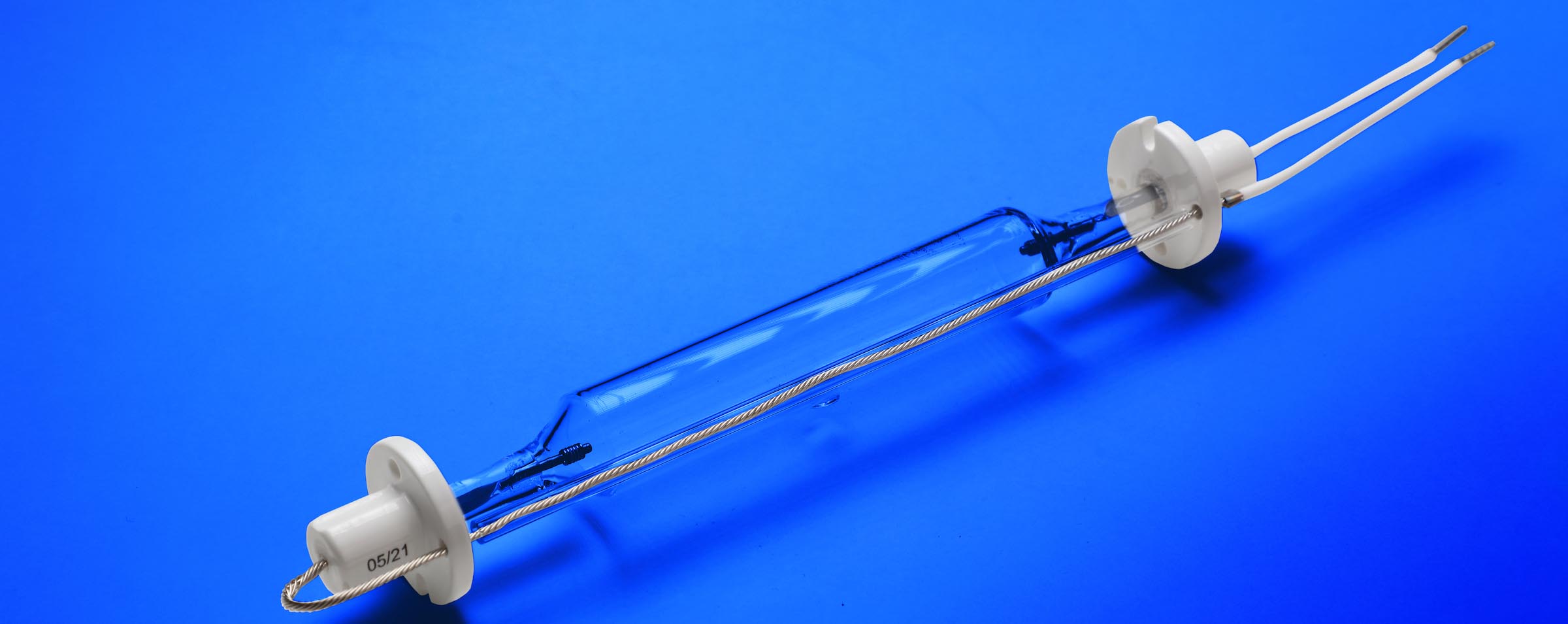
- Low-pressure mercury lamps: LightSources low-pressure mercury lamps convert about 40% of electrical power to UV-C at 254 nm.
- High-output quartz lamps: LightSources high-output quartz lamps produce up to 66% more UV output than standard lamps of the same length.
- Pellet amalgam lamps: LightSources pellet amalgam lamps deliver up to 3x the UV-C output of comparable standard lamps of the same length, which shortens room cycles.
- LongLife+ coating: LightSources LongLife+ coated lamps operate up to 16,000 hours and reduce output depreciation on high-intensity lamps.
- Far-UVC excimer lamps: far-UVC 222 nm lamps for applications near people.
- Shatter ProTech: a LightSources proprietary coating that contains glass and mercury if a lamp breaks, which matters for robots that move through patient areas.
Robot makers can choose ozone-generating or ozone-free lamps. The ozone-generating option passes 185 nm, and the ozone-free option blocks it. For the science behind each wavelength, read how germicidal UV systems target pathogens in air, water, and surfaces.
OEM UV lamp engineering for disinfection robot makers
LightSources works with robot manufacturers as an OEM co-engineering partner, not only a lamp supplier. LightSources engineers match lamp length, output, base, and ballast to the robot’s column, power budget, and cycle-time targets, and the LightSources Rapid Prototype Program moves custom lamp designs from sample to production. LightSources is an ISO 9001:2015 registered manufacturer and an ITAR Registered Manufacturer.
Talk to Our Engineering Team about lamps for your next UV disinfection robot.
Frequently asked questions about UV light disinfection robots

These answers cover common questions about UV light disinfection robots in hospitals and other facilities.
Are UV disinfection robots still used after the COVID-19 pandemic?
Yes. Hospitals adopted UV disinfection robots to fight multidrug-resistant organisms and C. difficile years before COVID-19, and the BETR Disinfection trial that supports their use ran from 2012 to 2014. Healthcare-associated infections remain a daily risk, so robots remain part of many terminal cleaning programs.
What is the difference between a continuous UV robot and a pulsed xenon robot?
A continuous UV robot runs low-pressure mercury or amalgam lamps that emit steady UVC 254 nm light, while a pulsed xenon robot fires short, high-intensity flashes across a broad UV spectrum. Both are used for room disinfection, and the lamp type affects cycle time, lamp replacement, and cost of ownership.
What should a hospital look for when choosing a UV disinfection robot?
A hospital should look for a robot that verifies the dose it delivers, stops automatically when someone enters, and fits its room turnover times. Ask for independent efficacy data on the pathogens you target, lamp life and replacement cost, cycle logging, and how the unit handles shadowed areas.
Can UV disinfection robots be used outside hospitals?
Yes. Schools, transit vehicles, hotels, gyms, laboratories, and offices use UV disinfection robots after hours, when rooms are empty. The same rules apply everywhere: clean surfaces first and keep people out of the room during the cycle.
Do UV disinfection robots produce ozone?
Only if they use ozone-generating lamps. Ozone-free lamps block the 185 nm line that creates ozone, and LightSources makes both ozone-free and ozone-generating versions so robot makers can choose the right lamp for each application.
LAMP PRODUCT DATA:
LAMP APPLICATIONS:
LightSources designs and manufactures germicidal UVC lamps for OEMs that build UV disinfection robots, carts, and room systems. As an ISO 9001:2015 registered manufacturer, LightSources supports robot makers from lamp selection through prototypes and production. Contact Us to learn more about LightSources UVC lamps for UV disinfection robots.

This post is also available in:
 Vereinfachtes Chinesisch

 Spanisch