
UV disinfection water treatment uses germicidal UVC, most commonly at 254 nm, to inactivate susceptible microorganisms as water passes through a properly designed treatment chamber or reactor. LightSources engineers UVC lamps for OEM water-treatment equipment used in drinking water, industrial processing, aquaculture, wastewater, water reuse, recreational water, high-purity water, and marine applications.
The lamp supplies the UVC energy, but final treatment performance depends on the complete system. Flow rate, UV transmittance, delivered dose, reactor geometry, hydraulic conditions, quartz-sleeve transmission, sensors, controls, and maintenance all affect the exposure the moving water receives.
For broader guidance on reactor design, pretreatment, lamp selection, and validation, explore LightSources’ UV Water Purification guidance. For a closer look at how flow, UV transmittance, irradiance, and exposure time work together, read Understanding UV Water Disinfection.
Ultraviolet Disinfection of Water
UV disinfection of water is a physical treatment process that exposes waterborne microorganisms to germicidal UVC so they can no longer replicate effectively. The process is used as a microbial-control step in systems ranging from compact point-of-entry units to large municipal, industrial, aquaculture, reuse, and marine reactors.
The EPA Ultraviolet Disinfection Guidance Manual explains microbial response, reactor validation, dose monitoring, flow, UV transmittance, lamp status, sensors, aging, fouling, and operating conditions for public drinking-water UV systems. The same engineering principle applies more broadly: the treatment claim belongs to the complete reactor operating under defined conditions, not to the lamp by itself.
UVC 254 nm and the Treatment Chamber
UVC 254 nm is the primary wavelength used in conventional low-pressure UV water disinfection systems. LightSources low-pressure mercury lamps convert about 40% of electrical power to UVC at 254 nm for germicidal applications.
In a typical reactor, water moves past one or more lamps protected by UV quartz sleeves. The sleeves isolate the lamps from the water while transmitting UVC into the treatment zone. Lamp position, sleeve diameter, chamber dimensions, inlet flow, and the distance between the lamp and the water path all influence how that energy is distributed.
The electrical design matters as well. Germicidal lamps and their electronic ballasts must match so startup behavior, operating current, power control, temperature, and lamp output stay within the intended equipment design.
How Flow Rate and Water Quality Affect UV Dose
UV dose starts with a simple relationship: irradiance multiplied by exposure time. In a flowing reactor, however, water does not follow one uniform path or receive one uniform level of UVC.
| UV Dose = Irradiance × Exposure Time | D = E × t |
Using common water-treatment units, mW/cm² × seconds = mJ/cm².
Higher flow generally shortens residence time in a fixed chamber. Low UV transmittance, suspended solids, color, scale, organic material, or sleeve fouling can also reduce the UVC reaching microorganisms. Reactor design therefore has to account for dose distribution across the full hydraulic path, not only a theoretical average.
The EPA UV Treatment Toolkit emphasizes operating UV reactors within their validated flow and water-quality range and accounting for lamp aging, quartz-sleeve fouling, sensor-window fouling, hydraulics, and instrumentation in long-term performance planning.
UV Disinfection Water Treatment Benefits
UV water disinfection provides a controlled physical treatment step that can be integrated into many water-treatment processes without adding a disinfectant chemical at the point of UV exposure. Consistent performance depends on how the lamp, reactor, pretreatment, monitoring, and maintenance plan work together.
Common system-level benefits include:
- Microbial treatment without dosing chlorine or another disinfectant chemical at the UV stage.
- Continuous-flow operation for equipment ranging from compact point-of-entry systems to high-capacity industrial and municipal reactors.
- Treatment of susceptible bacteria, viruses, protozoa, and other microorganisms when the reactor delivers the required dose for the target organism.
- Integration with filtration, reverse osmosis, biological treatment, activated carbon, ozone, and other treatment processes.
- Conventional UVC treatment does not normally leave a downstream disinfectant residual, which can be useful where residual chemicals are undesirable.
What UV Disinfection Does Not Do
UV does not remove dissolved chemicals, salts, metals, or particles from water, and it does not treat water that bypasses the radiation field. Pretreatment may be needed when turbidity, suspended solids, hardness, iron, manganese, color, or other constituents reduce UV transmittance or promote quartz fouling.
For residential systems, the CDC overview of home water treatment systems notes that UV treatment works better when water is filtered before disinfection and that UV does not remove chemicals. Larger commercial and industrial systems follow the same basic principle: water quality reaching the reactor matters.
Conventional UVC also does not normally provide a continuing disinfectant residual after the water leaves the reactor. Drinking-water distribution, reuse, and other applications may require additional barriers or residual protection based on the complete treatment objective.
Where UV Disinfection Water Treatment Is Used
UV disinfection water treatment is used across applications with very different flow rates, water quality, microbial targets, operating environments, and regulatory requirements. The treatment objective determines how to configure the UVC lamp and reactor.
Drinking Water
Drinking-water UV systems are used in residential point-of-entry equipment, small-community systems, commercial installations, and municipal treatment plants. Flow, UV transmittance, pretreatment, required treatment credit, monitoring, and validation all influence the final equipment design.
For more detail on point-of-entry, community, and municipal applications, explore UV drinking-water disinfection
Industrial Process Water
Industrial systems may use UVC to control microorganisms in process water, recirculating loops, rinse water, ingredient water, cooling applications, and technical manufacturing processes. Equipment may need to accommodate continuous operation, variable water quality, high flow, compact footprints, or integration with filtration and reverse osmosis.
See industrial UV disinfection water treatment for application-specific information on manufacturing and process-water equipment.
Life Sciences and High-Purity Water
Pharmaceutical, laboratory, biotech, semiconductor, and other high-purity water systems can use UV at different points in the treatment loop for microbial control or specialized photochemical processes. Water chemistry, materials, sanitation procedures, loop temperature, flow, and the intended process determine the lamp and reactor requirements.
Review LightSources’ UV water treatment for life sciences for additional high-purity and technical-process applications.
Aquariums and Aquaculture
Aquarium and aquaculture equipment uses UVC to treat circulating water in commercial aquariums, recirculating aquaculture systems, hatcheries, fish farms, and research facilities. Flow, suspended solids, filtration, water clarity, quartz condition, and chamber placement all influence treatment performance.
Learn more about UV light for aquariums and aquaculture, including RAS placement, biofiltration, ozone integration, and maintenance.
Wastewater Treatment
Wastewater UV systems disinfect municipal and industrial effluent before discharge or further treatment. Variable flow, lower UV transmittance, suspended solids, and greater fouling potential can make pretreatment, lamp arrangement, hydraulic design, cleaning systems, and maintenance especially important.
Explore wastewater UV treatment for additional application guidance.
Water Reclamation and Reuse
Reclaimed-water systems can use UVC as one barrier in treatment trains designed around the source water and intended end use. Irrigation, cooling, industrial reuse, non-potable municipal reuse, and potable-reuse processes can require different pretreatment, monitoring, disinfection, and validation approaches.
See water reclamation and reuse for more on UV applications in reuse treatment trains.
Pools and Spas
Pool and spa UV systems treat recirculating recreational water as part of a broader water-quality program that also includes filtration and chemical treatment. High circulation rates, continuous operation, water chemistry, quartz fouling, and service access all influence lamp and equipment requirements.
Explore UV treatment for pools and spas.
Ballast Water Treatment
Marine ballast-water systems use UV within complete treatment systems designed to reduce the transfer of aquatic organisms between ports and ecosystems. Lamp selection has to account for treatment-rated flow, UV transmittance, salinity, temperature, vibration, corrosion exposure, power availability, service access, and the approved operating limits of the complete system.
The International Maritime Organization guidance on ballast-water treatment technologies explains that ballast-water management systems used to comply with the BWM Convention are subject to complete-system testing and type approval. LightSources supports UVC lamp engineering for ballast-water treatment systems.
UVC Lamp Technologies for Water Treatment Systems
Different UV water-treatment systems require different lamp technologies. Selection should start with the required treatment capacity, reactor footprint, flow, water temperature, electrical architecture, maintenance access, and operating range rather than lamp wattage alone.
Low-Pressure Mercury Lamps
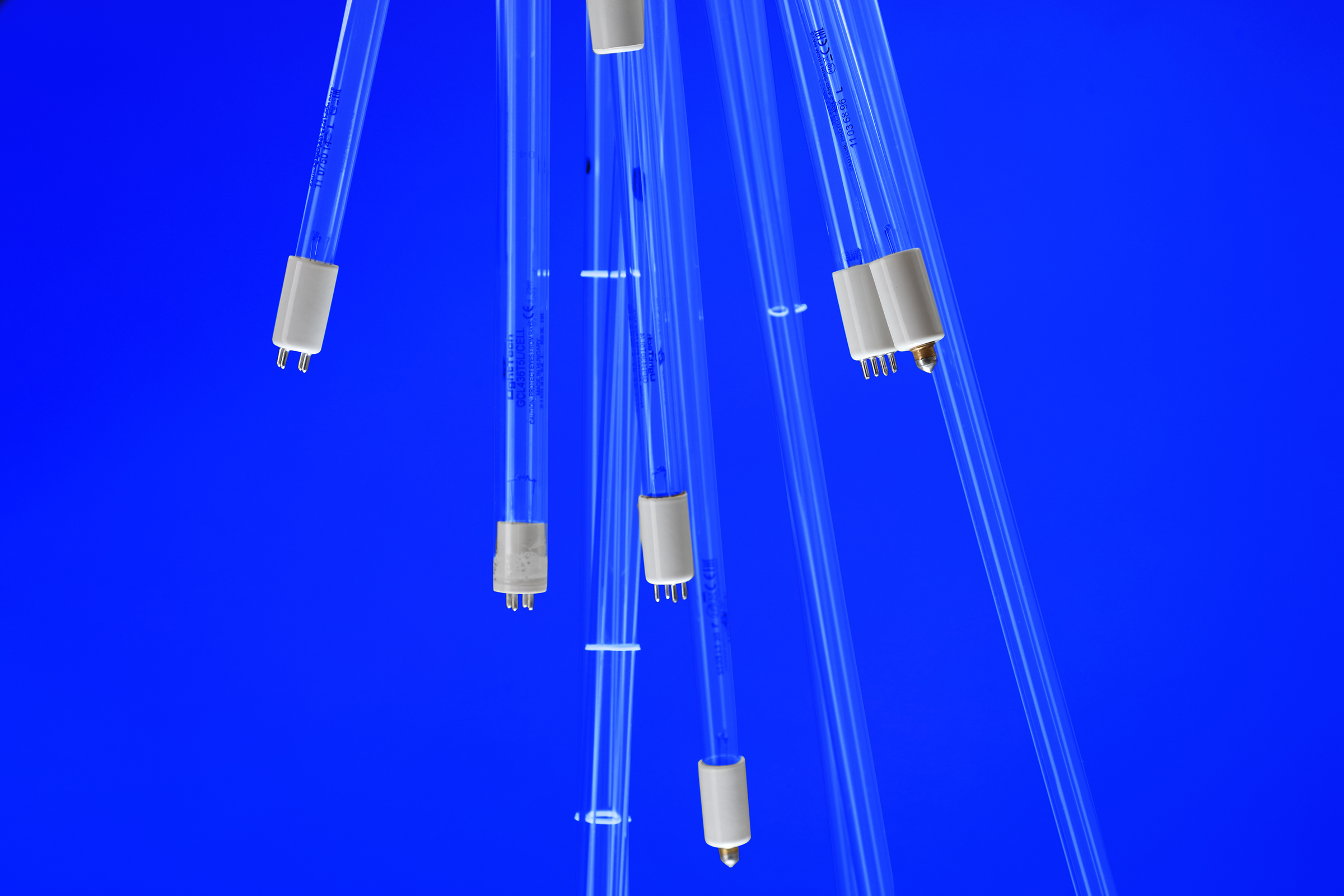
LightSources low-pressure mercury lamps convert about 40% of electrical power to UVC at 254 nm for germicidal applications. Their efficient 254 nm output supports water-treatment equipment where the reactor footprint can accommodate the required lamp length and lamp count.
LightSources high-output quartz lamps provide up to 66% more UV output than standard lamps of the same length. Higher output can help reduce lamp count or support greater treatment capacity within a defined footprint, but delivered dose still depends on the complete reactor.
Low-Pressure Amalgam Lamps
LightSources pellet amalgam lamps provide up to 3x the UVC output of comparable standard lamps of the same length. That additional output can support higher-capacity water-treatment equipment or reduce lamp count in some reactor designs.
Higher lamp output does not automatically produce 3x the delivered dose. Flow, UV transmittance, lamp placement, chamber hydraulics, quartz-sleeve condition, sensors, controls, and the validated operating range still determine treatment performance.
Medium-Pressure UV Lamps
LightSources medium-pressure UV lamps range from 100 to more than 700 W/in. Their higher power density can support compact or high-flow reactors, but the equipment must account for heat load, cooling, electrical demand, quartz protection, controls, and service access.
Ozone-Generating UV Lamps for Specialized Processes
Standard microbial water disinfection and intentional ozone generation are different process objectives. LightSources ozone-generating UVC lamp options are designed to transmit 185 nm for equipment that intentionally uses ozone generation or another photochemical process as part of the treatment train.
These applications require separate evaluation of process chemistry, materials, ventilation, oxidation byproducts, monitoring, and downstream treatment. They should not be treated as interchangeable with conventional 254 nm microbial disinfection.
Maintenance and Long-Term UV Performance
UV disinfection equipment requires routine maintenance because lamp output and optical transmission change over time. Quartz sleeves and sensor windows can accumulate mineral scale, organic deposits, biofilm, and other fouling that reduces the amount of UVC reaching the water.
A practical maintenance program may include lamp inspection and replacement, quartz-sleeve cleaning, sensor checks, alarm response, flow verification, ballast checks, and confirmation that water quality remains inside the equipment’s intended operating range.
LightSources LongLife+ technology supports operating life up to 16,000 hours and reduces output depreciation on high-intensity lamps. Actual service intervals still depend on the lamp platform, duty cycle, operating temperature, starts, ballast behavior, end-of-life margin, and the OEM maintenance program.
Frequently Asked Questions
These questions address common design and performance considerations for UV disinfection water treatment systems.
How does UV disinfection work in water treatment?
UV disinfection exposes susceptible microorganisms to germicidal UVC as water passes through a controlled radiation field. The treatment system must deliver the required dose at the rated flow and water-quality conditions for the intended microbial target.
What wavelength is commonly used for UV water disinfection?
UVC at approximately 254 nm is widely used in conventional UV water disinfection systems. LightSources low-pressure mercury lamps convert about 40% of electrical power to UVC at 254 nm for germicidal applications.
How do flow rate and UV transmittance affect UV dose?
Higher flow generally reduces the time water spends in a fixed UV chamber, while lower UV transmittance reduces how far UVC can travel through the water. The reactor therefore has to be sized around the expected flow range and the poorest water quality it is designed to treat, not only ideal conditions.
Does UV disinfection replace filtration or chemical treatment?
Not necessarily. Filtration can remove particles that reduce UV transmission or shield microorganisms, and some drinking-water, reuse, or process applications may still require chemical treatment or a downstream disinfectant residual. Select UV as part of the complete treatment train.
How do OEMs select a UV lamp for water-treatment equipment?
OEM lamp selection starts with the treatment objective, target wavelength and output, design flow, UV transmittance, reactor dimensions, water temperature, electrical architecture, quartz protection, service access, validation requirements, and expected operating life. Evaluate the lamp with the reactor, not by wattage or length alone.
OEM UV Lamp Engineering for Water Treatment Equipment
LightSources works with water-treatment OEMs to align the UV lamp with the reactor, operating environment, electrical architecture, production plan, and long-term replacement requirements. Support can begin during early equipment development and continue through prototyping, production scale-up, change management, and lifecycle supply.
For more detailed engineering and program information, review these LightSources resources:
- OEM UV lamp engineering partnership for design-stage collaboration, custom development, prototype support, and lifecycle supply.
- UV lamp applications for OEM systems for liquid disinfection, ozone generation, and other functional UV applications.
- UV lamp engineering capabilities for wavelength, geometry, electrical, thermal, quartz, ballast, prototype, and manufacturing considerations.
LightSources supports OEM programs through ISO 9001:2015 registered manufacturing, the Rapid Prototype Program, and custom UV lamp design. Talk to Our Engineering Team to discuss lamp output, geometry, ballast compatibility, quartz integration, operating conditions, and lifecycle requirements for water-treatment equipment.
UVC Lamps for UV Disinfection Water Treatment
Reliable UV disinfection water treatment depends on the relationship among lamp output, reactor geometry, water quality, hydraulics, monitoring, maintenance, and validation. Defining those conditions early gives OEM teams a clearer basis for selecting the UVC lamp platform and supporting the equipment through production and long-term service.
LAMP PRODUCT DATA:
LAMP APPLICATIONS:
LightSources engineers UVC lamps around the optical, electrical, thermal, mechanical, and lifecycle requirements of OEM water-treatment equipment. Standard and custom lamp development supports OEM programs from prototype through controlled production and long-term replacement supply. Contact LightSources to discuss lamp requirements for UV disinfection water treatment.